Showing posts with label Rolling Stones. Show all posts

Monday, November 11, 2013

Jack for a Day

Woohoo! I'm so excited about this post since it's quite a unique theme (I think): songs with 'Jack' in the title! Interestingly, five of these six songs are performed by artists east of the Atlantic.
Alright, we're starting with a real poptastic tune by those energetic Brits of Manfred Mann. Originally performed by John Simon for the 1968 counter culture semi-documentary You Are What You Eat, The Manfreds really spiffed up "My Name is Jack" for a single that same year. This "Greta Garbo Home for Wayward Boys and Girls" mentioned in the lyrics was an actual building in San Francisco but was more of a hippie hotel than a children's home. While it was a #8 hit in the UK, the US single was recalled when Mercury Records complained about the phrase "Super Spade" in the lyrics, which referred to a Haight-Ashbury drug dealer. The release was delayed by a week until the offending name was re-recorded as "Superman." Performing on the German TV show The Beat Club, "My Name is Jack" features Manfred Mann himself on keyboards, Mike d'Abo on lead vocals, and Klaus Voorman on bass (dear friend of The Beatles who designed their Revolver album). My kid knows all the words to this happy tune!


------------------------------------------------------------------------------------------------------------------
If you like the British psych/garage band genre, you'll surely enjoy The Smoke, a short-lived English group that existed from 1965-67. With the exception of being big in Germany, they never really broke internationally, but the quartet did have one hit with "My Friend Jack" in 1967 (#2 in Germany, #45 in UK), which is interpreted by some as an LSD anthem (something about Jack eating sugar lumps?). Whether that's the case (and The '60s Beat does not promote drug-use!), it's a pretty good tune with cool, echoing fuzz guitars, trippy lyrics, and killer riff. Here's more great footage from The Beat Club.  


------------------------------------------------------------------------------------------------------------------
This next little gem is brought to you by Four Jacks and a Jill, a South African folk rock ensemble. They originally formed in 1964 without a "Jill" under a different name. Later, they added lead singer Glenys Lynne and changed the group's name. After scoring a hit in their native country, they cracked the American charts in 1968 with the song "Master Jack," the Billboard chart at #18 and #3 on the contemporary chart. The song also reached #5 on the Cashbox and went to #1 in South Africa, Canada, Malaysia, and Zimbabwe. With prophetic lyrics from 1968, this sweet tune by Four Jacks and a Jill has a poignant message about South African politics.

------------------------------------------------------------------------------------------------------------------------
Here's the upbeat "Happy Jack" by The Who, a #3 hit in the UK and #24 in the US in the spring of 1967. It's composer, Pete Townshend, can be heard at the end of the song shouting "I saw you!" and it is said that he was noticing drummer Keith Moon trying to join in secretly to add his voice to the recording, something the rest of the band disliked. Townshend reported the song is about a man who slept on the beach where he vacationed as a kid. The kids on the beach would laugh at the man and once buried him in the sand. However, the man never seemed to mind and only smiled in response. Featuring Moon's energetic drummer, here's a great footage of The Who performing "Happy Jack," live at The Marquee in '67.  

----------------------------------------------------------------------------------------------------------------
Percy Mayfield's tune, "Hit the Road Jack," was made famous by America singer-songwriter-pianist Ray Charles with the Raelettes vocalist Margie Hendricks. The song, which has a strong beat, is a brief, rather comic duet between a fed-up woman and her good-for-nothing man. He tries to wheedle her into letting him stay, but she will have none of it, "'cause it's understood: you ain't got no money, you just ain't no good. Charles' recording hit #1 for two weeks on the Billboard chart in October 1961, as well as #1 on the R&B chart, and also got the Grammy Award for Best Rhythm & Blues Recording. Ranked among Rolling Stones magazine's "500 Greatest Songs of All Time," here's a great live performance of "Hit the Road Jack."

---------------------------------------------------------------------------------------------------------------------
And our final 'Jack' song of the day is no other than the good ol' "Jumpin' Jack Flash" by The Rolling Stones. Called "supernatural Delta blues by way of Swinging London" by Rolling Stone, the song is considered by some as the band's return to their blues roots after the psychedelia of their preceding albums. Recorded and released in spring of 1968, this Jagger/Richard's tune is one of the group's most popular and recognizable songs, featured in films and covered by numerous artists including Aretha Franklin. With a distinctive guitar sound, as well as one of the greatest guitar licks of all time, "Jumpin' Jack Flash" reached the top of chart in the UK and #3 in the US, and has been performed on every Stones tour since its release. Here's one of The Stone's promo videos from 1968 that showcases the band lip-syncing and wearing interesting make-up. Oh, you guys...
 

Monday, May 20, 2013

The Rollings Stone: 50 & Counting

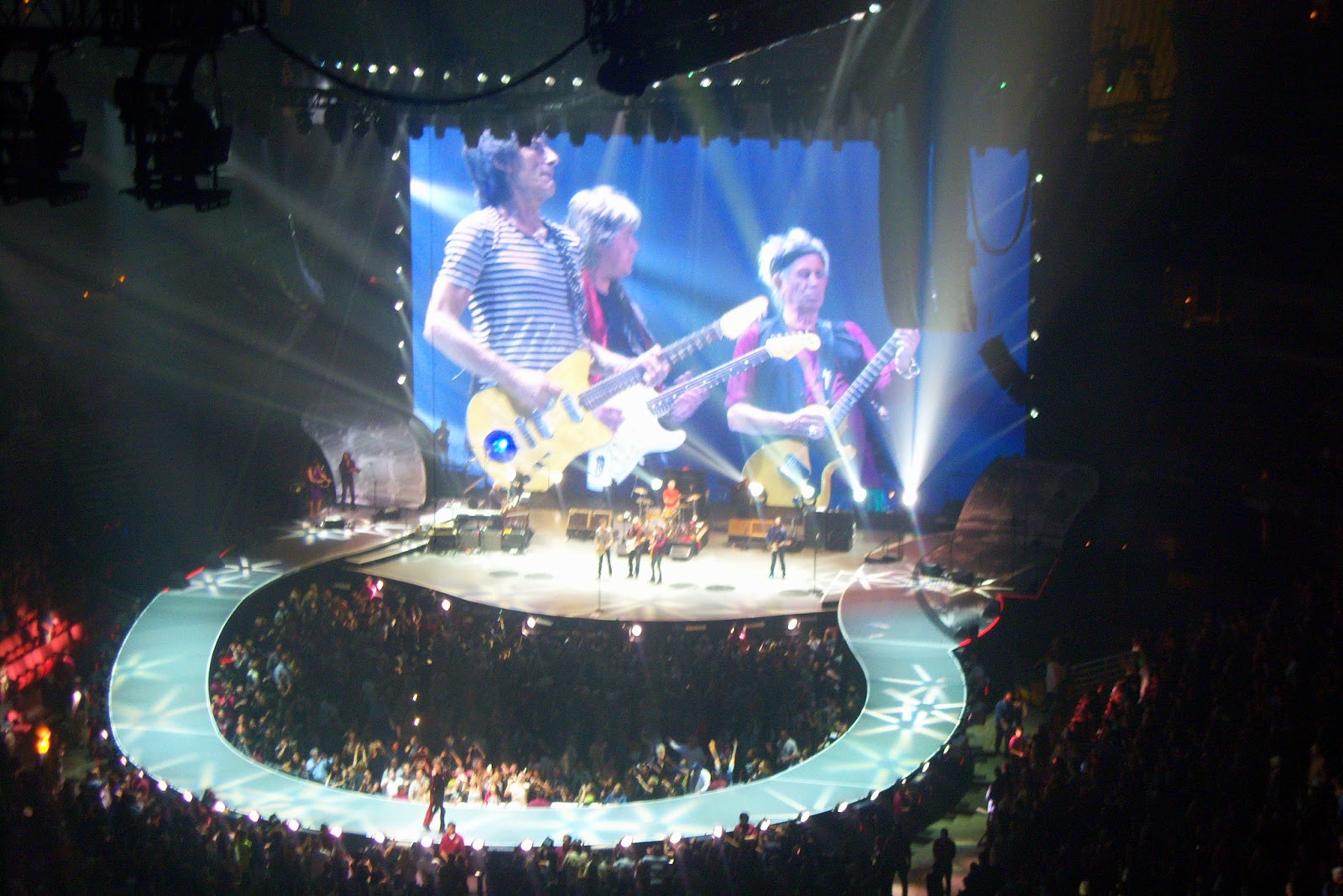
On Saturday, May 18th, a friend and I checked off a box on our bucket-list: attend a Rolling Stones concert! The Stones are some of the oldest rockers out there, but they are still going strong after fifty years since they first formed. As part of their ongoing 50 & Counting Tour, these Brits put on an awesome show at the Honda Center ("The Pond") in Anaheim, CA, and there's nothing like seeing their incredible energy and impressive talent in person! The arena took quite awhile to fill up, giving us ample time for people-watching (the audience was also a sight to behold), but once the concert began 50 minutes late, it was a near full house and we were in for a treat with over two hours of solid music.
High-energy Mick Jagger belted on vocals, jammed on harmonica, and strutted on the catwalk around the tongue pit. Keith Richards and Ronnie Wood (member since 1975) both wailed on guitar, and Charlie Watts (also a founding member with Jagger and Richards) rocked out on drums. No wonder these guys are so skinny! Their support musicians were also excellent and a great addition, including two backup singers, keyboardist, bass player, and sax players They performed over 20 hits from throughout their lengthy career, including "Get Off of My Cloud," "Paint It Black," "Gimme Shelter," "Wild Horses," "Honky Tonk Women," "Start Me  Up," "Brown Sugar," and 3-song encore with "You Can't Always Get What You Want," "Jumpin' Jack Flash," and "(I Can't Get No) Satisfaction." One of the top guitarists of all time, Mick Taylor (Stones member from '69-'74), was a featured guest, joining the band on "Midnight Rambler," and Dave Grohl of Foo Fighters (and Nirvana) also made a guest appearance on guitar. With the exception of the massive pot-smoke that enveloped us during the performance, it was a stellar show! Here we are, ready to rock to out! 


The stage incorporating their infamous lips and tongue logo. 

You can see Jagger out front on the catwalk (don't laugh at my faraway seat, but the only way I'd pay the $600 for the good seats is if it included the time machine to see The Stones back in the '60s!). 

And because it wouldn't be the '60s Beat without a performance from back in the day, here's the classic tune The Stones opened the concert with. Written as a reaction to their sudden popularity after the success of "Satisfaction" in 1965, "Get Off of My Cloud" topped the charts in the US and UK in November of 1965. Cultivating their infamous "bad boy" image, the lyrics are defiant and rebellious, a common practice for The Stones around that time. 
 And for the first part of the concert's encore, The Stones performed "You Can't Always Get What You Want," featuring a full choir and French horn player. Written by Jagger and Richards and released in July of 1969, it was named the 100th greatest song of all time by Rolling Stone magazine in its 2004 list. The three verses (along with the varied theme in the fourth verse) address the major topics of the 1960s: love, politics, and drugs. Each verse captures the essence of the initial optimism and eventual disillusion, resigning to a practical approach in the chorus. Minus the choral introduction, here's a performance on The David Frost Show in 1969 (live vocals only).
Happy 50th Anniversary to The Rolling Stones, and thank you for a night to remember!

Thursday, November 15, 2012

Crossfire Hurricane

Sorry for the lack of posts (long story) but I just wanted to give a quick (and last-minute!) shout-out to all you Rolling Stones fans out there and let you know about the latest presentation from HBO Documentary Films called Crossfire Hurricane. It airs tonight, folks! When I was personally contacted by social media manager Lisa French, here's what she wrote: "The Rolling Stones, rock ‘n’ roll icons who have defined creativity, daring and durability, are to be chronicled in a kaleidoscopic new film that will debut November 15 on HBO. CROSSFIRE HURRICANE provides a remarkable new perspective on the Stones’ unparalleled journey from blues-obsessed teenagers in the early ‘60s to the rock royalty they have become.
Academy Award Nominated Director Brett Morgen (THE KID STAYS IN THE PICTURE) says, “CROSSFIRE HURRICANE invites the audience to experience firsthand the Stones' nearly mythical journey from outsiders to rock and roll royalty. This is not an academic history lesson. CROSSFIRE HURRICANE allows the viewer to experience the Stones' journey from a unique vantage point.  It's an aural and visual roller coaster ride.”

CROSSFIRE HURRICANE premieres Thursday, November 15th @ 9pm only on HBO.
Check out the trailer!


And in case you didn't catch that last bit, "crossfire hurricane" is taken out of a lyric in the Stones' 1968 hit "Jumpin' Jack Flash." Written by Mick Jagger and Keith Richards, this return to the group's blues rock roots reached #1 in the UK and #3 in the US, and has become a staple in every Rolling Stone concert since. Here's a classic live performance by The Stones in Hyde Park, London, in the summer of '69.


Apologizes for the late notice, but don't forget to check this film out tonight!

Tuesday, October 16, 2012

In The Ghetto

Protest Songs/ Message Music: Part 4
Well, I was originally intending to end this little series on Part 3, but decided to add one last post with a few more political songs, as well as ones with a social message. Oh, and in case you were wondering why the most famous protest song has been left out of this series, Barry McGuire's "Eve of Destruction" was previously featured here during Folk Rock Week.

Written by Mac Davis and recorded by Elvis Presley, "In the Ghetto" is a narrative on generational poverty: a boy child born to a mother with already too many mouths to feed in the ghetto of Chicago; the boy grows hungry, steals and fights, buys a gun, steals a car, runs, but is shot and killed just as his own son is born, thus continuing the cycle. Originally titled "The Vicious Circle," the structure of this gospel- style tune emphasizes this inescapable circle with its simple, stark phrasing and the repetition of "in the ghetto" at the end of every fourth line. Released in April 1969, this song was Presley's first Top-10 hit in the US in four years, peaking at #3, and his first UK Top-10 hit in three years. Known for taking his music seriously, here's a passionate live performance by the King in '69.
---------------------------------------------------------------------------------------------------------------------------
One of The Rolling Stones' most politically inclined works to date would be "Street Fighting Man" from their 1968 album Beggars Banquet. Originally titled and recorded as "Did Everyone Pay Their Dues?," Mick Jagger (with Keith Richards) allegedly wrote this about Tariq Ali after Jagger attended a March 1968 anti-war rally at London's U.S. embassy, during which mounted police attempted to control a crowd of 25,000. Released as a single in the US in August 1968, this rock tune only managed #48 on the charts, despite its popularity, because many radio stations refused to play the song based on what were perceived as subversive lyrics. Since, it has been covered by many other artists and it ranked #301 of the 500 Greatest Songs of All Time. Here's live footage of "Street Fighting Man," taken from the Stones' last tour of the 1960s. 
------------------------------------------------------------------------------------------------------------------------

In March 1968, The Doors released a very dramatic single, "The Unknown Soldier," written jointly by the band members. This psychedelic rock song was Jim Morrison's reaction to the Vietnam War and the way the conflict was portrayed in American media at the time, with lyrics describing how the news was being presented in the living rooms of ordinary people. In the beginning of the song, a mysterious organ sound depicts the mystery of the "unknown soldier," and by the middle, the song turns into a military cadence complete with a military drum beat and the sound of Sergeant counting off, followed by a drum roll and rifle shot. As you'll see in this footage, the group gets pretty theatrical with this performance, with Robby Krieger aiming his guitar at Morrison like a rifle and Morrison falling to the floor after the drummer plays a rimshot. Peaking at #39 on the Billboard charts, here's the dynamic "Unknown Soldier" live by The Doors.
-------------------------------------------------------------------------------------------------------------------------
Our final "message song" of the day comes from Motown with "Love Child" by Diana Ross & The Supremes, the group's eleventh #1 single in the US. Written by The Clan (Motown's staff songwriters), this pop/psychedelic soul tune is notable for its then-controversial subject matter of illegitimacy, with lyrics about a woman who grew up as a "love child" asking her boyfriend not to pressure her, in fear of creating a love child themselves. Released in September 1968, this single knocked off and kept The Beatles' massive "Hey Jude" off the top spot in the US, the last of five replacements at #1 between The Beatles and The Supremes (the two most popular music acts in America during the 1960s). Going on to outsell all of the The Supreme's previous or subsequent singles, here's the debut of "Love Child on the season premiere of The Ed Sullivan Show, September 29th, 1968. (Ed Sullivan performance removed from YouTube).

Thursday, July 21, 2011

Those Darn Kids and Their Music

Banned Songs: Part 1
So how about a three-part segment of songs that were either banned or edited for the radio due to questionable lyrics?!
For anyone that knows a little about The Beatles, they probably can guess a few of their tunes were banned including "A Day in the Life" (for lyrics about a graphic car accident) and "Lucy in the Sky with Diamonds" (which was thought to be a drug reference, however, it was based upon drawing by John Lennon's son). "I Am the Walrus" was another of those banned songs, although it's quite clear what substance contributed to some of these lyrics. Released in November 1967 as the B-side to "Hello, Goodbye," Lennon composed this psychedelic rock song by combining three songs he had been working on. He also added a verse of nonsensical words when he had a learned that a teacher at his old primary school was having students analyze his lyrics. The walrus is a reference to Lewis Carroll's "Walrus and the Carpenter" (from the sequel to Alice In Wonderland), however, Lennon was 'bummed' when he later learned that the walrus was the 'bad guy.' From their 1967 TV film Magical Mystery Tour, here's a Beatles tune banned by the BCC for a couple of inappropriate lines.

------------------------------------------------------------------------------------------------
And here's Peter, Paul, and Mary, the beloved folk group just discussed a few posts ago. Although they were often politically outspoken in their lyrics, their only song to actually be banned was "Puff, the Magic Dragon," a simple song about the loss of childhood innocence. Based upon a 1959 poem written by 19-year-old Cornell student Leonard Lipton, an acquaintance of Peter Yarrow (of the trio), Lipton was given half of the songwriting credits along with Yarrow after the song's release in 1963. Throughout the sixties, there was lots of speculation about the lyrics referring drugs leading to its ban in several countries, but the authors consistently deny this rumor. Since, this song is considered a popular children's classic, and has become a part of American and British pop culture.

------------------------------------------------------------------------------------------------
From Portland, Oregon, The Kingsmen were a garage rock band best known for their 1963 recording of Richard Berry's "Louie Louie." It held the #2 spot on the Billboard chart for six weeks and is still well-known today. However, because of lead singer/rhythm guitarist Jack Ely's indistinguishable enunciation of the lyrics (try saying that ten times fast!), the song became immediately controversial, with millions of teenagers and their parents thinking it was "dirty." As a result, the governor of Illinois banned it, and the FBI even got involved investigating the lyrics, but found nothing. The words are, in fact, innocent, which you can actually hear a bit clearer in this video footage from Shindig! compared to the garbled vocals on the original recording.

------------------------------------------------------------------------------------------------
Finally, we all know that The Rolling Stones were the 'bad boys' of the British Invasion as their music was often quite suggestive. Written by Mick Jagger and Keith Richards, "Let's Spend the Night Together" was released as a double A-sided single with "Ruby Tuesday" in January 1967, and was definitely controversial at the time. On the Ed Sullivan Show, the band was initially not allowed to perform this song, but a compromise was met by changing the lyrics to "let's spend some time together." However, during the live performance, Jagger clearly rolled his eyes at the TV camera every time he sang that line (seen in this footage below). This, combined with their antics backstage (something about wearing Nazi uniforms), Ed Sullivan announced the band was banned for performing on the show again.

Friday, April 15, 2011

Downtown

British Invasion: Part 3
Boy, the variety of styles that came along with the British Invasion is quite impressive, and today's post has some of the most contrasting artists so far!

First off today, it's the sweet, British singer and actress Petula Clark, who actually got her professional start well before the Invasion. Known as "Britain's Shirley Temple," Petula first began her career on the BBC radio as a child actor, even touring the country to entertain the troops in WWII. After making her singing debut in the late 1940's, it wasn't until the '60s when she became a international success. In November of 1964, Petula became the first female UK artist to have a #1 hit in the US with "Downtown." Written by Tony Hatch about his first time in New York City, this song won the Grammy Award for "Best Rock 'n' Roll Song" in 1965, and was also awarded a Gold Record for over 1 million sales.

-----------------------------------------------------------------
Initially forming in 1958, the English beat group, The Tremeloes, were first signed to Decca Records in 1962, being chosen over The Beatles after the two groups had auditioned. Although they hit the charts with "Twist and Shout" in 1963 (a cover song also recorded by The Beatles), it's wasn't until some personnel changes and a record label change in 1967 that the group gained their biggest success with songs like "Here Comes My Baby" and "Silence Is Golden." The latter, first performed by the American group The Four Seasons, hit #1 on the UK charts in May of 1967, earning the gold disc status, and was one of the top 100 songs of that year. With The Tremeloes' strong vocal harmonies, this post-Invasion song still carries the essence and quality of the British Invasion era.

--------------------------------------------------------------------------------------------
Although they were originally from Manchester, England, Freddie and the Dreamers were categorized as another Beatle-inspired Merseybeat group, however, their stage act was a hilarious sight, lead by the antics of 5 foot 3 frontman Freddie Garrity, who bounced around stage. Among a string of hit records during the Invasion, "You Were Made for Me" hit #3 on the UK charts in November of 1963, and clearly demonstrates Freddie's "unique" dance style that actually led to another US hit, "Do the Freddie." I grew up hearing about "doing the Freddie," but now it finally all makes sense. Pretty goofy, but interesting that these guys were the first of three consecutive Manchester groups to have a number one hit.

-------------------------------------------------------------------------------------------
And to conclude today's post on the other side of the spectrum, we have the bad boys of the British Invasion: The Rolling Stones (though they sure don't look too bad in this early photo of their short-lived matching-suit look!). Coming out of London's club scene playing many rhythm and blues covers, The Stones gained international success with the #1 hit "(I Can't Get No) Satisfaction" in the summer of 1965. Written by Mick Jagger and Keith Richards, this (early) hard rock song's distinctive opening guitar riff (with fuzzbox effect) and racy lyrics established The Stones' look as rebellious, troublemakers compared to the adorable, "moptop" image of The Beatles. Initially only played on pirate radio stations, "Satisfaction" has since been considered one of the all-time greatest rock songs (#2 on that 500 list) and has become a staple at Rolling Stones concert, being performed on nearly every tour since its release. Here's great live performance from The Ed Sullivan Show!

Tuesday, March 22, 2011

Ruby TUESDAY Afternoon

Songs for Each Day of the Week: Day 3

Alright, so it's Tuesday, and oh boy, you're in for a real treat with two classic songs! First up, it's The Rolling Stones' "Ruby Tuesday," a double A-side single (backed with "Let's Spend the Night Together") that reached #1 on the U.S. charts after its January 1967 release. Written by guitarist Keith Richards about his girlfriend in the mid-1960's, this is another great tune included in the list of the 500 Greatest Songs of All Time. The talented Brian Jones played the recorder and piano, and the double bass was actually played jointly by bassist Bill Wyman and Keith Richards, with Wyman pressing the strings against the fingerboard and Richards bowing the strings. And in case you were wondering, yes, this song's title was the source of the restaurant chain of the same name. Here are the great Stones performing on The Ed Sullivan Show.

-----------------------------------------------------------------------------
The other classic song of the day is "Tuesday Afternoon" by the English symphonic rock band The Moody Blues. Initially titled "Forever Afternoon (Tuesday?)" and presented in two parts on their 1967 album Days of Future Passed, this dream pop/psychedelic pop song was edited down and re-released as the single "Tuesday Afternoon" in July of 1968. Featuring (the beautiful) Justin Hayward on lead vocals and acoustic guitar, he wrote this song while sitting in a field near his home in England one spring afternoon, and this song just came to him as he strummed his guitar. The backing melody comes from the mellotron (an early synthesized keyboard), played by Mike Pinder, and the short flute solo at the end is played by member Ray Thomas. Inspired by The Beatles' use of classical instrumentation, the album version of this song ends with a final orchestral rendition of the chorus, played by the London Festival Orchestra. Although this performance is not without its pitch problems as it is not an easy song to perform live, there's still something special about seeing this classic footage of the "Moodies."

Wednesday, February 23, 2011

The Not-So-Usual Suspects

Psychedelic Week: Part 2
As you may have noticed, psychedelic music mainly emerged from the
folk-rock and blues-rock bands of the 60's, which bridged the transition to eventual genres like progressive rock, glam rock, hard rock, and influenced sub-genres like heavy metal. However, psychedelic rock also had an impact on mainstream pop and rock, leading to groups who you wouldn't expect to produce some psychedelic sounds as well.

A group influential in developing the music style of psychedelic rock was the American rock band, The Byrds, with their March 1966 single, "Eight Miles High." From Los Angeles, the group initially founded the genre of folk rock by combining the influence of the British Invasion bands with contemporary and traditional folk music. Later into the 1960's, The Byrds became significant in other genres such as raga rock (East Indian influence) and country rock, in addition to psychedelic, making them one of the most influential bands of the 1960's.


------------------------------------------------------------
As a kid, a psychedelic pop song I loved listening to on my parents' record player was, "Crimson and Clover," by American rock 'n' roll group, Tommy James and the Shondells. Wanting to change the direction of the group's sound, singer-songwriter/guitarist Tommy James and drummer Peter Lucia Jr. wrote this single and released it in November of '68. The song uses a cool tremolo effect on the guitar that vibrates in time with the song's rhythm, and at the end of the song, they use the same vibrating effect on Tommy's vocal part, "crimson and clover, over and over..." This performance comes from the Ed Sullivan Show in January 1969, one week before the single reached #1 on the charts. By the way, does anyone else find Tommy a little creepy in this performance?


---------------------------------------------------------------
Initially a folk-rock musician, Scottish singer-songwriter, Donovan, was also influenced by the sounds of U.S. West Coast bands (like Jefferson Airplane), which led him to develop a unique style that combined folk, pop, jazz, psychedelia, and world music. After Donovan's first psychedelic record,
Sunshine Superman, became an American chart breakthrough in 1966, Donovan released the psychedelic/folk/acid rock song, "Hurdy Gurdy Man," in May of '68. He wanted to reach a wider audience in the U.S. where hard-rock artists (like Jimi Hendrix) were becoming quite popular, and as hoped, it became one of Donovan's biggest hits. On many of Donovan's recordings, he used session guitarist, Jimmy Page (later, of Led Zeppelin), though it's uncertain which guitarist is on this recording. Using a similar tremolo effect on the vocal part like "Crimson and Clover," "Hurdy Gurdy Man" is a harder rock sound than Donovan's previous music, using a variety of distorted guitars.
-------------------------------------------------------As you will eventually come to find out, I have a soft spot for the American band, The Monkees. Originally created for a zany TV show in 1966 and only allowed to sing on their first two albums, The Monkees fought "the system" and earned the right to write, record, produce, and play their own music. Singer-songwriter Michael Nesmith wrote a poem (full of psychedelic imagery) about the riots in '67 on the Sunset Strip in Hollywood, and then set it to music as "Daily Nightly." This song features a Moog synthesizer and comes from The Monkees' fourth album, which was one of the first rock/pop albums to pioneer the use of this new synthesizer. Also one of the first to own this instrument, singer/drummer Micky Dolenz actually had no idea how to play the synthesizer, however, he makes wonderfully creative use of its psychedelic sound in this song, as heard in this video from their (normally in color) TV show. The first time my husband heard this song, he asked if it was Jefferson Airplane. Apparently, Grace Slick and Micky Dolenz have a similar quality to their voices (see last post with the video of "White Rabbit").
-----------------------------------------------------------------------
Typically a folk rock/sunshine pop band, the American vocal group, The Mamas and The Papas, also ventured into psychedelic territory in the late 60's. Released in May 1968, the group became more experimental with their album The Papas and the Mamas, especially with the Jimi Hendrix-like guitar sound in "Gemini Childe," as well as the more down-beat, darker sound in the song "Mansions" (posted below). Still with their signature sound of four-part vocal harmonies arranged by the band's songwriter, John Phillips, the group recorded "Mansion" in the home of John and his wife, Michelle (also a founding member of the group). Until today, I actually had never heard this haunting song before; I know, what kind of Mamas and Papas fan am I?


---------------------------------------------------------------
And now to finally end this post, it's The Rolling Stones performing, "Paint It, Black" on the Ed Sullivan. Another written by Mick Jagger and Keith Richards, and released in May 1966, this psychedelic/raga rock song was a new direction for the normally rock 'n' roll/bluesy rock group. Also on the 500 Greatest Songs of All Time list, it was the first #1 single to feature a sitar, which was played by the multi-instrumentalist of the group, Brian Jones. Influenced by the use of the sitar in The Beatles' "Norwegian Wood," Brian taught himself to play the Eastern instrument after a visit with the sitar-playing Beatle, George Harrison. Definitely a favorite Stones song of mine.

Monday, February 14, 2011

Baroque Pop

Baroque Pop Week: Part 1
So I discovered the term Baroque Pop this past year and although I've always been familiar with the type of songs in this genre, I was delighted to find out this lovely music had a specific name. Originating in the mid-1960s, Baroque Pop is a style of music that uses elements of classical music in rock 'n' roll songs, as well as classical instrumentation such as harpsichord, oboe, cello, French horn, and string quartet. Bands that have produced baroque pop songs include The Beatles, The Left Banke, The Beach Boys (circa 1965-1968), and The Zombies, as well record producer Phil Spector's Wall of Sound productions (one of the first to add classical instruments to pop music, creating more majestic/dramatic sound). At first listen, I assumed that much of The Mamas & The Papas' music was included in this genre as well since they often have string accompaniment, however, their music is considered to be Sunshine Pop (and folk-influenced). These two genres are similar in subject matter, but Sunshine Pop is considered more "sunny"-sounding while Baroque Pop is darker with a more melodramatic edge (more on that genre at another time).

From July 1966 comes The Left Banke's hit song "Walk Away Renée," considered the first recognizable baroque pop single. This beauty was composed by the New York group's then 16-year-old keyboard player Michael Brown and Tony Sansone, and includes a lush string orchestration, a harpsichord accompaniment, a falling chromatic bass line, and flute solo interlude (an idea Mike Brown got from The Mamas & The Papas' song "California Dreamin'").


Okay, so here I go talking about The Beatles again, but their venture into baroque pop was a very significant turning point for the group. Although the song "Yesterday" was their first song to use string accompaniment, it was "Eleanor Rigby" that really continued the band's transformation from a mainly pop-oriented act to a more experimental studio band. Released in August of 1966, this song, written by Paul McCartney (though of course credited to Lennon/McCartney) won the 1966 Grammy for Best Contemporary Vocal Performance. It's double string quartet orchestration was composed by The Beatles' producer, George Martin, and Paul's choice to use strings may have been influenced by his interest in composer Antonio Vivaldi. "Eleanor Rigby" comes from the album Revolver, as displayed in the YouTube post of this song (no video footage, just audio).


Another example of early Baroque Pop is The Rolling Stones' song "As Tears Go By," written by front-man Mick Jagger, guitarist Keith Richards, and their manager, Andrew Loog Oldham. This was one of the first compositions by Mick and Keith (up until this point, they mostly did covers of blues standards), and it was released in December of 1965. Although it seems to be inspired by The Beatles' "Yesterday" (August 1965) with melancholy lyrics and lush string accompaniment, The Stones actually wrote this much earlier in 1964, but were not the first to make it famous. It was first a popular hit for British singer Marianne Faithfull who released it in '64. Here's The Rolling Stones' performance on The Ed Sullivan Show (but if only those girls would stop screaming!). EDITED: Original video was removed from youtube, but this video is a black and white footage of the same performance with the original recording overdubbed.


And although this wasn't the plan, I'm now going down a bunny-trail by including Marianne Faithfull's Hullabaloo London performance of "As Tears Go By." Although the 17-year-old's vocals are lovely, Marianne's performance is a bit too stoic and she is clearly lip-syncing. The accompaniment is different than The Stones 'version with an English horn (sounds like a low oboe), but still includes the strings. This footage is actually quite bittersweet, especially if you know of the sad drug history that followed this seemingly innocent Marianne.


Okay, I really could keep posting songs all day, but I'll conclude this post with "A Whiter Shade of Pale," the debut song by the British group Procol Harum. Released at the beginning of the "Summer of Love" (May 1967), this baroque rock song reached #1 in several countries and has become an enduring classic (more than 900 versions covered by other artists are known!). Although the instrumental melody on Hammond organ makes clear references to Johann Sebastian Bach's "Sleepers, Wake!" and "Air on the G String," the song is not a direct copy or paraphrase of Bach's music. This is the second video that the group made of this song, as the first video was banned from the Top of the Pops TV show because it had footage from the Vietnam War. Fun seeing footage of 1967's London in this video:


Stay tuned for another overwhelming post of Baroque pop songs later this week!