Protest Songs/ Message Music: Part 4
Well, I was originally intending to end this little series on Part 3, but decided to add one last post with a few more political songs, as well as ones with a social message. Oh, and in case you were wondering why the most famous protest song has been left out of this series, Barry McGuire's "Eve of Destruction" was previously featured here during Folk Rock Week.
Written by Mac Davis and recorded by Elvis Presley, "In the Ghetto" is a narrative on generational poverty: a boy child born to a mother with already too many mouths to feed in the ghetto of Chicago; the boy grows hungry, steals and fights, buys a gun, steals a car, runs, but is shot and killed just as his own son is born, thus continuing the cycle. Originally titled "The Vicious Circle," the structure of this gospel- style tune emphasizes this inescapable circle with its simple, stark phrasing and the repetition of "in the ghetto" at the end of every fourth line. Released in April 1969, this song was Presley's first Top-10 hit in the US in four years, peaking at #3, and his first UK Top-10 hit in three years. Known for taking his music seriously, here's a passionate live performance by the King in '69.
One of The Rolling Stones' most politically inclined works to date would be "Street Fighting Man" from their 1968 album Beggars Banquet. Originally titled and recorded as "Did Everyone Pay Their Dues?," Mick Jagger (with Keith Richards) allegedly wrote this about Tariq Ali after Jagger attended a March 1968 anti-war rally at London's U.S. embassy, during which mounted police attempted to control a crowd of 25,000. Released as a single in the US in August 1968, this rock tune only managed #48 on the charts, despite its popularity, because many radio stations refused to play the song based on what were perceived as subversive lyrics. Since, it has been covered by many other artists and it ranked #301 of the 500 Greatest Songs of All Time. Here's live footage of "Street Fighting Man," taken from the Stones' last tour of the 1960s.
------------------------------------------------------------------------------------------------------------------------
In March 1968, The Doors released a very dramatic single, "The Unknown Soldier," written jointly by the band members. This psychedelic rock song was Jim Morrison's reaction to the Vietnam War and the way the conflict was portrayed in American media at the time, with lyrics describing how the news was being presented in the living rooms of ordinary people. In the beginning of the song, a mysterious organ sound depicts the mystery of the "unknown soldier," and by the middle, the song turns into a military cadence complete with a military drum beat and the sound of Sergeant counting off, followed by a drum roll and rifle shot. As you'll see in this footage, the group gets pretty theatrical with this performance, with Robby Krieger aiming his guitar at Morrison like a rifle and Morrison falling to the floor after the drummer plays a rimshot. Peaking at #39 on the Billboard charts, here's the dynamic "Unknown Soldier" live by The Doors.
Our final "message song" of the day comes from Motown with "Love Child" by Diana Ross & The Supremes, the group's eleventh #1 single in the US. Written by The Clan (Motown's staff songwriters), this pop/psychedelic soul tune is notable for its then-controversial subject matter of illegitimacy, with lyrics about a woman who grew up as a "love child" asking her boyfriend not to pressure her, in fear of creating a love child themselves. Released in September 1968, this single knocked off and kept The Beatles' massive "Hey Jude" off the top spot in the US, the last of five replacements at #1 between The Beatles and The Supremes (the two most popular music acts in America during the 1960s). Going on to outsell all of the The Supreme's previous or subsequent singles, here's the debut of "Love Child on the season premiere of The Ed Sullivan Show, September 29th, 1968. (Ed Sullivan performance removed from YouTube).
These next four groups each have a rockin' horn section, and fused jazz with rock and roll.
Formed in Chicago, Illinois, in 1967, this American 'rock band with horns' shortened their name from Chicago Transit Authority (because the actual CTA threatened legal action), and launched a successful career selling over 38 million records, charting five #1 album and scoring 21 Top-10 hits. Chicago is one of the longest running and most successful rock groups, second only to The Beach Boys in terms of chart successes among American bands (the two bands actually had a successful joint tour together in the mid-'70s, being one of the highest grossing tours of that time). Before the band later moved to softer sound, they started off with some great, rockin' tunes in the late '60s and early '70s, like their first Top-5 hit "25 or 6 to 4." Recorded in August 1969 (although not released until the following summer), this hot song was written by one of the band's founding members, Robert Lamm, and features Peter Cetera on lead vocals and a great guitar solo with wah-wah pedal by Terry Kath. The title is actually a reference to a songwriter trying to write at 25 (or 26) minutes to 4:00 in the morning. Although the audio is out of sync, here's a rare, "studio" video filmed a few years later.
------------------------------------------------------------------------------------------------ From New York City in 1967, Blood, Sweat & Tears was a "jazz-rock" band known for infusing a multitude of styles including rock, blues, pop music, horn arrangements, and jazz improv. Founded by musician Al Kooper (an important figure in historic sessions with Bob Dylan and Jimi Hendrix), this eclectic group first appealed to the musical counterculture of the '60s, before going through many personnel changes and becoming a commercial, mainstream success. With the signature voice of Canadian lead singer David Clayton-Thomas, the band won the Grammy Award for Album of the Year with their second LP, beating out The Beatles' Abbey Road. One popular tune from this album was "Spinning Wheel," which peaked at the #2 position on the charts for three weeks in July of 1969, and actually topped the Billboard easy listening chart, even crossing over into the R&B chart. Written by Clayton-Thomas and arranged by the band's saxophonist Fred Lipsius, this song also won the Grammy Award for Best Instrumental Arrangement. What a classic sound!
------------------------------------------------------------------------------------------------- Formed in a Chicago suburb in the mid-'60s, The Ides of March were another jazz fusion band, best-known for their huge hit "Vehicle" in 1970. Released on the Warner Bros. Record label, at the time, "Vehicle" was the fastest-selling song in Warner's history, and reached #2 on the Hot-100, selling over a million copies and of course earning a gold disc. With the song's success, the group toured extensively throughout 1970, supporting many top acts including Jimi Hendrix, Janis Joplin, and Led Zeppelin. After an extended hiatus between 1973 and 1990, the original members reunited, and have been active since (even recording a double live album in Glen Ellyn, Illinois in 2002; sorry, personal shout-out to my sister's residence!). While this video incorporates cool footage from NASA's space program in the '70s, you can't beat this funky sound by The Ides.
------------------------------------------------------------------------------------------------ Our final song of the day is a psychedelic soul/funk one by American soul singer Edwin Starr from Nashville, Tennessee. Joining Motown Records in 1968, his biggest success came with the release of "War" in 1970, an anti-Vietnam War protest song that is considered the most popular protest song ever recorded (even earning compliments from contemporary protestor John Lennon). Originally recorded by The Temptations in '69, the label decided to withhold their version (as to not alienate their conservative fans), and using Starr's intense vocals instead, his version hit #1 on the US charts, as well as #3 on the both R&B chart and the UK chart. Accented by a heavy horn section, this tune became an anthem for the antiwar movement and a cultural milestone, still popping up today in movie soundtracks and in hop hop music samples. Not the best quality video but Starr's James Brown-influenced soul shout and funky moves are loud and clear.
Alright, we're beginning another full post with a fun, instrumental classic by Herb Alpert & The Tijuana Brass. Originally a show tune from the Rodgers' & Hammerstein 1959 musical The Sound of Music, "My Favorite Things" has become a popular Christmas selection, likely because of the wintertime imagery in the lyrics. With the unmistakable trumpet-playing style of Herb Alpert, this quick rendition comes from the group's Christmas album (their eleventh release) in December of 1968.
------------------------------------------------------------------------------------------------ Now, this next song has absolutely nothing to with Christmas, except for the fact that its titled "Holiday." So why include it on this post? Why not! Written by Barry and Robin Gibb of The Bee Gees, these two brothers share lead vocals in this haunting song that is primarily in a minor key with a strong organ presence. Released as a single in the U.S. in September 1967 (although not released in their native England), this song remained a concert favorite for over 30 years, with Maurice Gibb sometimes providing comedic antics by attempting many failed attempts to join in with his brothers.
------------------------------------------------------------------------------------------------- Up next is an original Christmas song performed by Motown girl group The Supremes. Released in November 1965, "Twinkle Twinkle Little Me" was the B-side of their holiday single that year and was featured on their album Merry Christmas, which peaked at #6 on the Billboard Holiday charts. Here's a sweet, little tune with a nice photo montage for ya.
------------------------------------------------------------------------------------------------ On a completely different note, this next seasonal tune comes from Here Come the Brides, an American comedy Western TV series that first aired on ABC in 1968. "St. Day Carol" is a Cornish Christmas song that dates back to the 19th century, and is beautifully performed here by Bobby Sherman and David Soul (who were propelled into stardom after their roles in this show). Singer/actor Sherman became a teen idol during the late '60s and early '70s while Soul went on to star in the TV show "Starsky & Hutch" in the mid-'70s.
------------------------------------------------------------------------------------------------- And our last song of this post, it's New York girl group The Ronettes with their fun version of "Sleigh Ride." With its well-known "Ring-a-ling-a-ling Ding-dong-ding" background vocals, this song was featured on a Christmas album with several other artists, all produced by Phil Spector, and was titled A Christmas Gift for You from Philles Records. At the time, the album was a relative flop because it was released the same day as President Kennedy's assassination on November 22nd 1963, but since has been ranked among the 500 Greatest Albums of All Time, with original pressings selling now for $500! Here's another cute photo montage, however the performance footage is clearly from a different Ronettes song.
Soul Music: Part 4
Continuing with successes from Hitsville, USA (a.k.a. Detroit, MI), American soul singer Jimmy Ruffin had several hits in the '60s and '80s, and is the older brother of David Ruffin of The Temptations. First joining Motown Records in 1961, followed by a few years of service in U.S. Army, Ruffin finally scored his breakthrough hit in June of 1966 with "What Becomes of the Brokenhearted." This beautiful ballad was his only Top-10 hit, peaking at #7 on the Billboard charts and #6 on the R&B Singles chart, and remains one of the most revived of Motown's hits. The original recording initially included a spoken introduction by Ruffin, however, it was left out of the final mix, thus making for an extra-long instrumental intro. The only video footage I could find comes from a performance that Ruffin gave on British TV in about 1975, which does include those original spoken lines at the beginning.
------------------------------------------------------------------------------------------------ Before they were known as Smokey Robinson & the Miracles (from 1965 through 1972), The Miracles were the first successful act for the Motown Record Corporation. Not only were they one of Motown's signature groups of the 1960s, but their leader, Smokey Robinson, became one of most successful songwriters and record producers of all time. Even maintaining success during the British Invasion, they were actually a major influence on many British bands at the time. Among their fifty hits that charted, their first million-selling single was "Shop Around" released in the fall of 1960. Written by Robinson and Motown CEO Berry Gordy, this early soul single reached #1 on the R&B charts, #1 on the Cashbox, and #2 on the Billboard charts. Although not included in the video footage, the female in the group, Claudette Robinson was Smokey's wife who sang background vocals. Here's another classic tune ranked among the 500 Greatest Songs of All Time.
------------------------------------------------------------------------------------------------- Frequently featured on the '60s Beat, Diana Ross & the Supremes are America's most successful vocal group to date, with twelve #1 singles on the Billboard chart. Their success helped make it possible for future African-American soul and R&B musicians to gain mainstream success. Their consecutive hit singles in the mid-'6os included "Stop! In the Name of Love," which remained at #1 for a few weeks during the spring of 1965, and was nominated for the 1966 Grammy Award for Best Contemporary Rock & Roll Group Vocal Performance. In addition to this song making the permanent collection of the 500 Songs that Shaped Rock and Roll, the song's choreography, with the outstretched "stop" gesture, is also legendary. Members of The Temptations taught the girls the routine backstage in London before their performance on a Ready, Steady, Go! special featuring Motown music, hosted by Motown enthusiast Dusty Springfield (as seen below!).
------------------------------------------------------------------------------------------------ Joining the Motown Records Corporation at the age of 11, American singer-songwriter and multi-instrumentalist Stevie Wonder is going on fifty years of a successful music career and is the most awarded male solo artist of all time. Although the 1970s saw his most classic era of recording, he did score some big hits while still a teenager in the '60s. Released on his seventh studio album in August of 1967, "I was Made to Love Her" peaked at #2 on the pop chart, and spent four straight weeks at #1 on the R&B chart. Written by Wonder with his mother Lula Mae Hardaway, Sylvia Moy, and producer Henry Cosby, this soul song features Wonder's signature harmonica sound in the introduction, as well as strings following the bridge section. The song has some interesting covers including a version by guitarist Jimi Hendrix with Stevie Wonder on drums. Although blind from birth, it's as if Wonder has a sixth sense for creating fantastic music.
------------------------------------------------------------------------------------------------ We'll conclude our Soul Series with a childhood favorite of mine, the long-lived American doo-wop and soul/R&B vocal group from New York City, The Drifters. Although the group was a revolving door with its members and peaked in popularity was from 1953 through 1963, splinter groups continue to perform today. Having a completely different lineup by 1958, led by Ben E. King ("Stand By Me"), these "New" Drifters are widely considered to be the "true" golden age of the group and have received Pioneer Awards from the Rhythm & Blues Foundation. Released at the end of 1962, "Up on the Roof" became a big hit in early '63, reaching #5 on the U.S. pop chart and #4 on the R&B chart. Written by the Brill Building songwriting team Gerry Goffin and Carole King, this timeless song has been described as "a remarkable pop song for 1962" with "first-rate, sophisticated writing." My family had a Drifters' Greatest Hits cassette tape that was played numerous times on roadtrips, yet this music really never gets old to me. Here's another one of those 500 Greatest Songs of All Time (#113), as well as one that Shaped Rock and Roll, performed by one of the 100 Greatest Artists of All Time (#81).
\
Jumping back into our Soul Series, we'll continue with The Righteous Brothers, the 'blue-eyed soul' musical duo featuring Bill Medley (bass vocals) and Bobby Hatfield (tenor). From Los Angeles, California, they adopted their name while performing together as part of a five-member group called The Paramours, when at the end of one performance, an African-American Marine in the audience shouted, "That was righteous, brothers!" Beginning their career as a duo in 1963 and continuing to perform together until Hatfield's death in 2003, they are known for recording the most played song in radio history. Released in December 1964 (note: during Beatlemania), "You've Lost That Lovin' Feelin'" became a #1 hit single in the US and the UK, and has since been ranked #34 of the 500 Greatest Songs of All Time. One of the foremost examples of producer Phil Spector's "Wall of Sound" technique, this song was one of the most successful pop singles of its time, even though the song's length exceed the standard for radio airplay then. Unfortunately, I heard this song so many times during my childhood that I've kind of lost that lovin' feelin' for it.
------------------------------------------------------------------------------------------------ One of the earliest African-American soul singing groups signed to Motown Records were The Contours, best known for their million-selling song "Do You Love Me?" Written and produced by Motown CEO Berry Gordy Jr., this rhythm and blues classic peaked at #3 on the pop charts and #1 on the R&B charts after its release in June 1962. Gordy had intended for The Temptations to record this song, but when he was unable to track them down at the moment, he turned to The Contours who were in danger of being dropped from the Motown label (their first two singles had failed to chart). After being offered Gordy's sure-fire hit, they immediately hugged and thanked him. In 1987, the song's popularity was revived after being featured in the film Dirty Dancing, resulting in the song's Billboard chart re-entry at #11. The lyrics name off many dance fads of the 1960s including the Mashed Potato and The Twist.
------------------------------------------------------------------------------------------------- American musician Ray Charles was a founding father of soul music in 1950s by infusing R&B, gospel, and blues styles into his music, and racially integrated country and pop music in the 1960s. Due to glaucoma, he was completely blind by age seven, however, it was while attending a school for the blind where he developed his musical talent. With his career spanning several decades from 1947 till his death in 2004, this Georgian native is considered one of the greatest singers of all time. He was also one of the first African-American musicians to be given artistic control by a mainstream record company. Released in September 1960, Charles' blues version of "Georgia on My Mind" received national acclaim and a Grammy Award, reaching the #1 spot that November. This recording inspired many cover versions to follow, and in 1979, was declared the official state song of Georgia.
------------------------------------------------------------------------------------------------ First featured during Motown Week, Martha and the Vandellas were one of the most popular performing acts from Motown Records during the mid-60s. With their hard-driving instrumentation sound, several of their songs are among the 500 Greatest Songs of All Time including "Nowhere to Run." Released as a single in February 1965, this pop/soul tune reached #8 on the pop charts and #5 on the R&B charts. Written by Motown main production team of Holland-Dozier-Holland, the Funk Brothers (Motown's studio musicians) used snow chains as percussion along side tambourine and drums to emphasize the heavy beat. Heavily played by the troops in the Vietnam War, its brass-heavy arrangement and chorus of "nowhere to run, nowhere to hide" have also made this a popular song at sporting events. Among many accolades over the years including one of the greatest artists of all time, these girls were awarded the Pioneer Award at the Rhythm & Blues Foundation in 1993.
Flower Power: Part 5
Today, all the groups featured have a female lead vocalist. This next group could definitely have been included during "Out-of-Towner" Week here at The '60s Beat. From the Hague, Netherlands, Shocking Blue was a Dutch rock band that first formed in 1967. With Mariska Veres on lead vocals, the group released the worldwide hit "Venus" in late 1969, taking them to the #1 spot on the U.S. charts in February 1970 and earning them a gold record. With global sales reaching over 5 million copies, "Venus" became the Netherland's first American #1 hit. Based on "The Banjo Song" by The Big Three in 1963 here (with Cass Elliot before she was a "Mama"), this song was written by Robbie van Leeuwen, who also played guitar and sitar in the band.
------------------------------------------------------------------------------------------------ One of the first female singer-songwriters of the rock 'n' roll era, Kentucky-born Jackie DeShannon first began her music career by singing country tunes on the radio at age 6. Recording minor hits in the early '60s, she gained attention when she joined The Beatles on their first U.S. tour, while composing songs for groups like The Byrds, and even forming a songwriting partnership with Jimmy Page (later of Led Zeppelin) (oh and she dated Elvis). In March 1965, DeShannon released her biggest hit, "What the World Needs Now Is Love" (written by Burt Bacharach), and by May, reached #7 on the charts. Although its release predates the Flower Power era, its message rang true throughout the rest of the '60s. In June 1968, right after the shooting of Robert Kennedy, this song was played continuously on L.A. radio stations as an audio vigil. This anthem for love has been performed by over 100 other artists and has been featured in several films.
------------------------------------------------------------------------------------------------ One creative group that seems to remain in the shadows is The Peanut Butter Conspiracy, a psychedelic pop/rock band from Los Angeles. Formed in August 1966 out of a folk rock group called The Ashes, this quintet was known for their unique blend of folk rock and psychedelia while incorporating strong male-female vocal harmonies, interesting chord progressions, and multiple time signature changes. Featuring the powerful vocals of Barbara "Sandi" Robinson, their only tune to actually chart was the groovy "It's a Happening Thing," released in 1967. Although it only reached #93 in the U.S., it was a lively flower pop anthem of the time.
------------------------------------------------------------------------------------------------- And of course we can't forget one of the first black acts to achieve complete and sustained crossover success (with audiences of all races), the international stars Diana Ross & the Supremes. At the height of the Summer of Love in '67, this top Motown act released their first single that embraced the sounds of psychedelic pop, influenced by the psychedelic sounds by bands like The Beatles and The Beach Boys. Representing a shift in the Motown pop sound in the late '60s, "Reflections" reached #2 on the Billboard charts by late summer, only verging on being the group's 11th American #1 single. Featuring one of the first early uses of a synthesizer on a pop record, this was also the last 45 released with Florence Ballad and Mary Wilson singing background vocals together. Written by the Motown production team Holland-Dozier-Holland, here's one of the group's first TV performances featuring Cindy Birdsong as Ballad's replacement (once again, apologies for the video 'obstruction.').
----------------------------------------------------------------------------------------------
Be sure to revisit posts including these female icons of the Flower Power era, singers Janis Joplin with Big Brother & the Holding Company, and Grace Slick of Jefferson Airplane ("Piece of My Heart" and "White Rabbit"/"Somebody to Love" featured here).
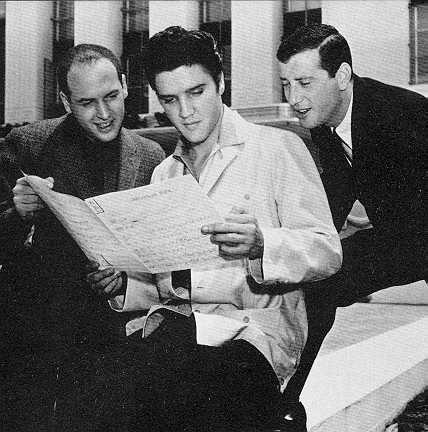
This week on August 22nd, the music world unfortunately lost TWO American songwriters: Jerry Leiber and Nickolas Ashford (discussed later in this post). Lyricist Leiber was the second half of the songwriting/record producing team with Mike Stoller (shown here with Elvis), and together, they created several ground-breaking hits that helped shape rock and roll history. Beginning their partnership in the early 1950s, their most popular songs include "Hound Dog," "Jailhouse Rock," "Kansas City," "Yakety Yak," "On Broadway" (with Mann & Weil), "Leader of the Pack" (discussed here), "Chapel of Love," and even "Stuck in the Middle With You." Smokey Joe's Cafe was a great Broadway musical revue from the mid-1990s that featured 39 pop standards written by Leiber & Stoller. Leiber passed away in Los Angeles at the age of 78 from cardiopulmonary failure. Thank you for the music, Jerry Leiber!
Here are some other hits by Leiber & Stoller during the 1960s. Co-written together with Ben E. King (co-principal singer with The Drifters), "Stand By Me" is one of the most-performed songs in history with over 7 million performances, and there are over 400 recorded versions by other artists. Released in May of 1961, this soul song went straight to #1 on the R&B charts and was a Top-10 hit on the U.S. charts twice. Among the 500 Greatest Songs of All Time, here's Ben E. King's TV performance of a true American classic (although I think it could do without the 'background dancers').
Another popular tune by Leiber & Stoller was "Love Potion No. 9," originally performed by The Clovers in 1959. The lyrics describe a man who goes to a gypsy for help in finding love, and she gives him a bottle of "love potion #9," which causes him to kiss everything he sees. This song was actually banned by some radio stations because of the line about "kissing a cop." The most popular version of this tune was performed by the Merseybeat/British Invasion group, The Searchers, who scored #3 on the U.S. charts with this song in 1965.
And I'll throw in one more Leiber & Stoller, just because I like this song. Originally performed by The Drifters (resulting in a major R&B hit in 1956), "Ruby Baby" later became a #2 hit on the Billboard charts when Dion released his version in 1962. Here's a TV performance of Dion's classic remake.
-------------------------------------------------------------------------------------------------
Nickolas Ashford and Valerie Simpson were a husband and wife songwriting/production team, as well as successful recording artists later in their career. First meeting at a Baptist church in 1963, the Ashford & Simpson partnership started out writing songs in the mid-1960s for artists like The 5th Dimension, Aretha Franklin, and Ray Charles, as well as joining the Motown staff in 1966. They wrote/produced most of the singles by vocal duo Marvin Gaye & Tammi Terrell, including "Ain't No Mountain High Enough" (featured on this past post). Including styles like R&B, soul, pop, disco, and gospel, they went on to create several songs into the 1970s and '80s. Throughout his career, Ashford played tambourine and percussion on hundreds of recording sessions, including dozens of Motown classics, like Marvin Gaye's "What's Goin' On." Ashford was 70 years old and passed away in New York this past Monday of complications from throat cancer.
Here are two tunes by the Ashford & Simpson team. Released in March of 1968, "Ain't Nothing Like the Real Thing" was first of two #1 hits on the soul singles charts for popular Motown duo Marvin Gaye & Tammi Terrell. Written and produced by Ashford & Simpson, they also provided background vocals for this song. Unfortunately, there are no live performances of these timeless love song on YouTube.
On his own, Ashford (and Frank Wilson) produced the mega hit "I'm Gonna Make You Love Me," which was recorded by Diana Ross & The Supremes with The Temptations in 1968. Quite a production including the Detroit Symphony Orchestra, this version hit #2 on both the U.S. Billboard charts and R&B charts in January 1969. Since there were no live performances by Diana Ross & The Supremes together with The Temptations, here is a duet performance by Ross with Stevie Wonder The Hollywood Palace around 1970.
New to The '60s Beat, Lou Christie was a popular American singer-songwriter known for his impressive, three-octave vocal range. Released in the spring of 1966, his song "Rhapsody In The Rain" caused a storm of controversy with its suggestive lyrics. With the opening melody inspired by Tchaikovsky's "Romeo and Juliet" (a music history refresher on that famous love theme here), the song tells of a teenager's regret over "what happened" in the backseat of a car during a rainstorm. Many radio stations banned the song, resulting in Christie re-recording a "toned down" version. Despite the ban, the song managed to hit #16 on the U.S. charts, with the controversy aiding its popularity. Backed by the familiar, female singers known as The Tammys, Christie effortlessly soars into falsetto vocals in this classic.
------------------------------------------------------------------------------------------------
A popular, American girl group in the mid-60s, The Shangri-Las were known for their heartbreaking, teen melodramas like their biggest hit, "Leader of the Pack." Although this is one of my least favorite songs of the decade (sorry Leiber & Stoller), it was a #1 hit in 1964 and is now even ranked among the 500 Greatest Songs of All Time. Despite its popularity, this song was banned by the BBC in the UK because it glorified motorcycle gangs. However, by the end of 1964, The Shangri-Las were quite an established act, getting to perform with The Beatles and touring with The Drifters and James Brown (who were surprised the girls were white) as well as with Dusty Springfield and The Zombies (whose drummer, Hugh Grundy, got to rev up the motorcycle backstage during the girls' live performances of this song). Here's Mary Weiss singing lead, backed by twin sisters Mary Ann and Marge Ganser, performing on I've Got a Secret with singer Robert Goulet on the motorcycle.
------------------------------------------------------------------------------------------------
Featured during Psychedelic Rock Week, we all know the story of how The Doors asked to change the lyrics to "Light My Fire" on The Ed Sullivan Show, however, Jim Morrison still sang "higher" in the live performance, resulting in their ban from the show. Since it's such a classic song, I thought I'd post the mellow, Latin-influenced cover version by the blind, Puerto Rican singer and guitarist, Jose' Feliciano. Released in 1968, Feliciano's interpretation brought him international success, reaching #3 in the US, and #1 in several other countries, earning him a gold disc, as well as two Grammy Awards including Best New Artist of the Year and Best Pop Song of 1969. However, Feliciano caused a lot of controversy that same year when he sang a slow, Latin-jazz version of the "Star Spangled Banner" at Game 5 of the 1968 World Series, resulting in the ban of his music by many radio stations.
------------------------------------------------------------------------------------------------
One of the biggest songs of 1967 was Van Morrison's "Brown Eyed Girl," his first single after leaving the British Invasion group Them (revisit Them, whose hit song "Gloria" was actually banned as well by a Chicago radio station in 1964). Written by the Northern Irish singer-songwriter, Morrison had to record an alternate, radio-edit version of this song since it was considered too racy and suggestive at the time, however, the original recording is widely familiar today, reaching over 9 million radio and TV air plays in 2009 (yeah, wow). Although this tune has become Morrison's signature song, he signed the record label without legal advice, and unfortunately has never received any of the royalties for writing or recording the song. Here's a very serious Morrison performing on American Bandstand.
----------------------------------------------------------------------------------------------
We'll finish this post with one of the premiere groups on Motown's roster, Martha Reeves and the Vandellas (check them out from Motown Week). Known for their harder, R&B sound, their 1964 release of "Dancing in the Street" is a signature song for the girls (and for Motown), and has become one of the most covered and popular songs in rock and roll history. Although it was recorded as an innocent dance single, the song was banned by many radio stations in concern that the song was a call to riot, as the Civil Rights Movement was just getting underway. Regardless, the song reached #2 on the U.S. charts, even becoming a global success. In 2009, it became one of 50 sound recordings to be preserved by the Library of Congress, and is #40 of the 500 Greatest Songs of All Time.
Motown Week: Part 3
Well, since we're having a heat wave this week here in Southern California, this final Motown post for the week will begin with a little "Heat Wave" by Martha Reeves & the Vandellas, one of the most successful Motown groups from 1963 to 1972. Charting over twenty-six hits, these girls are ranked #96 on Rolling Stones' list of the 100 greatest artists of all time, as many of their recordings have become a part of American culture. Their 1964 standard, "Dancing in the Street," has been one of the most covered songs in rock and roll history, however, their smash hit from 1963, "(Love Is Like a) Heat Wave," is likely the first song to represent the Motown Sound with its doo-wop call-and-response vocals, gospel beat, and jazzy flavor. Another written by the Motown production team, Holland-Dozier-Holland, this "Heat Wave" is timeless!
-------------------------------------------------------------------------------------------- Next up, it's the amazing singer-songwriter/multi-instrumentalist Stevie Wonder, who signed with Motown Records at the age of eleven in 1961 and continues to record for the company to this day! Blind since just shortly after birth, Wonder has recorded more than 30 Top-10 hits and has received 22 Grammy Awards, making him the most awarded male solo artist. One of his most popular early singles is the 1966 hit "Uptight (Everything's Alright)," which he co-wrote (along with Sylvia Moy and Henry Cosby) and recorded at just 15 years old. On the day of the recording, the song's lyrics were not available in braille, so Moy sang the lines to Wonder in the studio and he simply repeated the lines, never missing a beat in the recording session. Ranked at #5 on Billboard's Hot-100 All Time Top Artists, Stevie Wonder's music is pure classic.
------------------------------------------------------------------------------------------- One of the hottest Motown duos of the late-60's was Marvin Gaye and Tammi Terrell, who had their first big hit together with "Ain't No Mountain High Enough" in 1967 (written by Ashford & Simpson). Known as the "Prince of Motown," Marvin Gaye was the label's top-selling solo artist of the decade, and with his four-octave vocal range, he's ranked #6 among the 100 Greatest Singers of All Time. Tammi Terrell was the perfect musical match for Gaye, and with her easy-going nature with audiences and his laid-back approach, they were successful on stage. Unfortunately, their stardom together was short-lived after Terrell was diagnosed with a malignant brain tumor, which led to her death at the age of 24 in 1970 (and also tragic, Gaye was later accidentally shot to death by his own father in 1984). However, their voices live on with their signature, care-free, love duets like this.
--------------------------------------------------------------------------------------------- So maybe it's slightly inappropriate to finish Motown week with a non-Motown artist, but hey, it looks we're just wild and crazy here at The 60s Beat! Well, because it's relevant to soul music, we'll end this post with one of the greatest singers of all time, Aretha Franklin, "The Queen of Soul." Franklin is one of the most honored artists by the Grammy Awards, and since 1961, she has scored forty-five Top-40 hits on the Billboard charts. She also has the most million-selling singles of any female artist (14 total), and in 1987, was the first female artist to be inducted into the Rock and Roll Hall of Fame. After becoming a superstar with her 1965 hit, "Respect," Franklin went on to sing a string of hits throughout the 1960's (and beyond) including a classic cover of Dionne Warwick's "I Say a Little Prayer" in 1968. Written by Burt Bacharach and Hal David for Warwick, Franklin's version brought this tune back to the R&B Top 10 for a second time, also gaining her international success. This woman sure has some pipes!
Motown Week: Part 2
Probably one of most successful vocal acts to record for Motown Records (not to mention, one of the most successful in music history!) was The Temptations. In their five-decade career, they have sold tens of millions of albums and are said to be as influential to soul music as The Beatles were to rock and pop. Spanning several genres of music including R&B, doo-wop, funk, soul, disco, and adult contemporary, the group is also known for distinct choreography, unmistakable harmonies, and flashy suits. Written (in about 20 minutes) and produced by Smokey Robinson and Ronald White (member of The Miracles) for lead vocalist, David Ruffin, "My Girl" was released in December 1964, reaching #1 in 1965 and becoming The Temptations' signature song. Another song on the list of the 500 Greatest Songs of All Time, this tune is a pure classic in an era of classy artists.
--------------------------------------------------------------------------------------- A group of four friends from New Jersey, The Shirelles were the first major female vocal group of the rock and roll era, as well as the first female group to have a #1 hit single on Billboard chart with "Will You Love Me Tomorrow" in 1960. Although they were signed by Scepter Records, this group actually precedes Motown as a crossover sensation with white audiences. OK, so technically these gals don't belong in Motown Week, however, they're relevant to the R&B/pop sound of Motown. Another ranked among the list of The 500 Greatest Songs of All Time, this song was written by Gerry Goffin and Carole King, in which King used the same chord progression "Oh! Carol" (a song written about her by ex-boyfriend Neil Sedaka!). Also found on the list of The 100 Greatest Artists of All Time, here are The Shirelles giving a sweet, live performance in 1964.
----------------------------------------------------------------------------------- One of Motown's first singing superstars was Mary Wells, who, along with The Miracles, The Temptations, and The Supremes, was said to have "bridged the color lines in music at the time." Known as the Queen of Motown (until she left the company in 1964), Wells helped define the up-and-coming sound of Motown in the early 1960's with a string of hits, mainly composed by Smokey Robinson. Released in March 1964, her signature song, "My Guy," became one of the first Motown hits to break across the Atlantic, making Wells an international star. In fact, The Beatles invited her to open for their UK tour, therefore making her one of only three female artists to do so for The Beatles. Although Wells passed away at the age of 49 from cancer of the larynx, her voice will always live on in this time-honored song.
-------------------------------------------------------------------------------------------- Another significant group that contributed to the emerging sound of Motown was The Four Tops, a vocal quartet notable for their use of a baritone lead singer (Levi Stubbs) instead of the usual tenor. From 1953 to 1997, the four original members sustained a successful career for over four decades, performing a variety of genres including R&B, doo-wop, soul, pop, disco, hard rock, and adult contemporary. Written by the Motown production team, Holland-Dozier-Holland, "I Can't Help Myself (Sugar Pie Honey Bunch)" was a #1 hit in 1965, becoming one of the most well-known Motown tunes of the '60s, as well as another classic song among the 500 Greatest Songs of All Time.
Motown: Part 1
As a complete change of pace from the generally rock and pop posts of the last several weeks (which I'm a bit partial to), this week is featuring the upbeat sound of Motown! On April 14, 1960, founder Berry Gordy Jr. formed the Motown Record Corporation in Detroit, Michigan ("Motor Town"), merging his first record label, Tamla Records (from 1959), with his second label, Motown Records. Motown played a huge role with racial unification in popular music, becoming a successful crossover of pop-influenced soul music. The "Motown Sound" generally used tambourines to accent the beat, prominent bass lines, strong melodies, and call-and-response singing style (like gospel music). Another aspect of Motown's success was Gordy's use of the same studio musicians that recorded the instrumental track for the majority of Motown songs, a tight-knit group known as "The Funk Brothers." Featuring primarily African-American artists, Motown influenced the sounds of rhythm and blues, soul, hip hop, and pop music for the decades that followed.
Motown's first successful female vocal group was The Marvelettes, who set the standard for the Motown girl groups that followed like The Supremes. During their eight-year run on the Billboard charts, the group had several hit singles including 21 on the Hot R&B Songs (rhythm and blues) and 23 on the Billboard Hot 100. In August of 1961, the girls recorded Motown's first #1 Pop hit with their debut single, "Please, Mr. Postman," a song that was later covered by The Beatles and The Carpenters.
------------------------------------------------------------------------- One of the primary artists associated with Motown is Smokey Robinson, an American R&B and soul singer-songwriter, and record producer, as well as original member of Motown's first vocal group The Miracles. In addition to his successful solo career, Robinson's creative contribution to the label, along with his song compositions for several other artists, earned him the title the King of Motown. Written by Robinson and fellow group members Warren Moore and Marv Tarplin, The Miracles' "The Tracks of My Tears" is a beloved ballad from June 1965 that has been voted #5 in The Top 10 Best Songs of All Time and is one of the most recognized, most honored, and most covered songs (sung by other artists). Smokey Robinson's voice is a timeless classic.
-------------------------------------------------------------------------------------- The premier and most successful vocal act of Motown Records was the female singing group The Supremes, who, at their peak in the mid-1960's, even rivaled The Beatles in worldwide popularity. With a repertoire that included doo-wop, soul, Broadway shows tunes, psychedelic soul, and disco, the group had twelve #1 hit singles on the charts. After achieving mainstream success with Diana Ross singing lead vocals, Berry Gordy (as Motown president) changed the group's name to Diana Ross & The Supremes in 1967. Prior to their name-change, they released the hit single "You Can't Hurry Love" in July 1966, becoming another song included in the Rock and Roll Hall of Fame's 500 Songs that Shaped Rock and Roll. Written and produced by Motown's main production team, Holland-Dozier-Holland, here are the girls performing their signature song on The Ed Sullivan Show. (Sorry, original clip was removed due to copyright infringement.)
---------------------------------------------------------------------------------------- In 1968, a pop music family group joined Motown Records, going on to become one of the biggest pop-music acts of the 1970's. From Gary, Indiana, The Jackson 5 consisted of five talented brothers with the young Michael Jackson singing impressive lead vocals at the age of 11 (although publicized as 9 years old), and were probably the first black teen idols to appeal equally to all audiences (partial thanks to the successful promotional skills of Berry Gordy). Released in December 1969, "I Want You Back" became the Jackson's first #1 hit single, selling six million copies worldwide, and later ranking #120 in the list of the 500 Greatest Songs of All Time. From their first album, Diana Ross Presents The Jackson Five, here's the group's performance on their TV special in 1971.