Showing posts with label British Invasion. Show all posts

Tuesday, September 30, 2014

British Invasion Tour!

Well, it's been awhile since I've attended a concert, but looks like I picked a good one to get back into the swing of things! Last week at Harrah's Resort in Southern California, I witnessed the return of rock royalty on the British Invasion's 50th Anniversary Tour! Featuring iconic singers of the '60s rock revolution, the legendary lineup included Billy J. Kramer (&The Dakotas), Chad & Jeremy, Mike Pender (of The Searchers), Denny Laine (of The Moody Blues & Wings), and Terry Sylvester (of The Hollies and The Swinging Blue Jeans). What a treat seeing these musicians share the stage for the first time ever! Originally, Gerry & The Pacemakers were a prominent part of this tour, but after Gerry Marsden's forced pull-out due to illness, The Hollies' Terry Sylvester was a great addition to the ongoing tour. While I know many fans were disappointed to miss out on classic songs like "Don't Let the Sun Catch You Cryin'" and "Ferry Cross the Mersey," it was an enjoyable night of fine music!

All ready to go in my Union Jack attire, complete with vinyl record purse (which drew quite a bit of attention; a few people even asked to take a picture of it!). 

The night was really enhanced by the great mix of classic footage and live feed of each musician projected on the large screens on both sides of the stage. My seat was initially much further back but I was upgraded when a nice lady handed me an extra ticket!

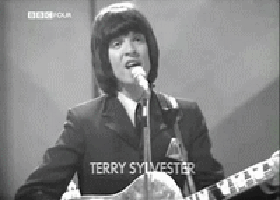
Although The Hollies' Terry Sylvester started off the show with a tune that most of the audience seemed unfamiliar with ("I Can't Let
Go"), he really got the crowd going with the hit "Bus Stop," followed by "Carrie Anne." Before he joined The Hollies in 1968 (replacing Graham Nash on the higher harmonies), Sylvester was a guitarist/vocalist with another British Invasion group, The Swinging Blue Jeans. It was great hearing him wail their hit single, "Hippy Hippy Shake" (#2 in the UK in late '63). He was a pleasant surprise and sounded really great! Here's classic footage of The Hollies performing "Carrie Anne," with Terry Sylvester playing guitar on the left.


-----------------------------------------------------------------------------------------------------------------------
Next in the lineup was another famous Liverpool musician, Mike Pender of The Searchers, and this guy was adorable! OK, maybe that's the wrong description because he really rocked
on guitar and his voice sounded fantastic, but his banter in between songs was, well, adorable. He had a great set of songs including "Sugar and Spice," "Don't Throw Your Love Away," "Love Potion No. 9," and "Needles and Pins" (even gave credit to Sonny Bono for writing that last one). All his famous guitar licks sounded spot-on on his beautiful Rickenbacker. Like The Hollies, Swinging Blue Jeans, Gerry & The Pacemakers, and The Beatles, The Searchers also emerged from the Merseybeat scene and have that distinct, jangly-guitar sound. It was great hearing it live! Here's The Searchers' remake of The Drifters' 1961 hit "Sweets For My Sweet," his lead-off tune on this tour.
------------------------------------------------------------------------------------------------------------------------

The third act of the night was the folk rock duo Chad & Jeremy, and these
talented blokes were hilarious!. They opened with the a cappella "You Are She," their last hit single from the '60s (or "we're going to sing this Acapulco for you," as Chad called it), but I can't for the life of me find the original recording (no thanks to YouTube and iTunes). But I was very impressed with their tight harmonies, and throughout the night, they even proved "they've still got it" with their guitar skills. They had the audience rolling with laughter as they told entertaining stories, even making fun of their appearances on American TV shows like Batman and The Dick Van Dyke Show. The backing band did join them on a few numbers like "Yesterdays Gone," "Willow Weep For Me," and "A Summer Song." I thoroughly enjoyed this guys. Here's classic footage of the duo's first hit single, 1964's "Yesterday's Gone" (arranged by film composer John Barry).

 ------------------------------------------------------------------------------------------------------------------------
After a brief intermission, another Liverpool lad was up next, Billy J. Kramer (originally with The Dakotas). While I most enjoyed the first half of the show, this part wasn't bad, but just not what I was expecting. Billy J. was a stud during the British Invasion, but I think he may of been having an off-night, plus I wasn't a fan of his current long hair. In the '60s, his manager was Brian Epstein (who also managed The Beatles), so Billy J. did give a nice tribute to Brian Epstein with his performance of a newer song called "To Liverpool With Love," and mentioned how he fought for Epstein to be inducted into the Rock and Roll Hall of Fame. Billy J. was friends with The Beatles, and he performed several of his hit songs written by Lennon-McCartney, including, "Bad To Me," I'll Keep You Satisfied," "From a Window," and "Do You Want to Know a Secret?" Here's a delightful 1964 performance of "Little Children," produced by George Martin; wasn't Billy J. a absolute doll back then?!
 ------------------------------------------------------------------------------------------------------------------------
For the final act of the night, Denny Laine of The Moody Blues concluded the show on a high note, killing on guitar and sounding great on vocals. Although likely unfamiliar to much of the audience, I was
pleasantly surprised by one his songs, "Say You Don't Mind," which became a hit when recorded in 1972 by Colin Blunstone (lead singer of The Zombies). Denny's set was surprisingly short but definitely sweet, finishing with The Moody Blues' first hit in 1964, "Go Now." After a standing ovation, the encore was a great "all hands on deck" rendition of Paul McCartney's "Band On The Run" (as Denny Laine was also a member of Wings with McCartney from '71-'81, this seems totally appropriate). So fun seeing all the musicians of the British Invasion tour having a blast together. Here's more great footage of Denny Laine leading The Moody Blues on "Go Now."

Thanks again to all these talented Brits for treating us to a great night!

Thursday, February 7, 2013

Farewell, Wild Thing

  On February 4th, we lost English singer-songwriter Reg Presley, best known as the lead singer of The Troggs. An active performer for over 40 years, Presley passed away from lung cancer at the age of 71. From Andover, Hampshire, his British Invasion band had a number of US and UK hits, including "Wild Thing," "Love Is All Around," and "With A Girl Like You" (featured here).
The Troggs were a highly influential rock and roll band whose sound was an inspiration for garage rock and punk rock. Presley started out as a bricklayer and kept up with this occupation until "Wild Thing" entered the UK singles chart in 1966. It reached #2 in the UK, #1 in the US, and sold over five million copies. With his distinct growl/lusty vocals and that memorable guitar riff, here's Presley and The Troggs in a promo video for "Wild Thing" (another song ranked among the 500 Greatest Songs of All Time).

Released in October 1967, "Love Is All Around" was composed by Presley, and reached #5 in the UK and #7 in the US later in May of '68. Covered by numerous artists, this version features a string quartet and a "tick tock" sound on percussion. After the first video taking place in a subway (or I mean, the underground), here's another cute video, this time on a train.
 

 Farewell, Reg Presley. You will always remain a legend of rock and roll.

Monday, May 2, 2011

The Heavy Second Wave

British Invasion: Part 9 (Second Wave, 1967-1970)

By 1967, the term 'roll' was generally dropped and the rock style of the 1960s emerged, also marking the end of the Invasion. However, from 1967-1970, the Brits did send off a much smaller 'second wave' of this newer rock sound (however, the official Second Invasion wouldn't take place until the 1980s). As the decade progressed, you can not only hear how much 'heavier' the music gets, but can also see a distinctive change in appearance, and boy, did hair get long! So hang on, we've got a whopping seven groups in this post!

First up, Cream was a British rock supergroup with bassist Jack Bruce on lead vocals, the bluesy guitarist/vocalist Eric Clapton (of The Yardbirds), and jazz-influenced drummer Ginger Baker, who created a hybrid of blues rock, hard rock, and psychedelic rock. They were the world's first notable and successful supergroup, selling over 35 million records in just the short two years that they were together. From their third album Wheels on Fire (the world's first platinum-selling double album), "White Room" was released as a single in September 1968, reaching #6 on the US charts and later becoming another among the 500 Greatest Songs of All Time. Recorded using an eight-track tape recorder (rare at the time), Clapton makes great use of the wah -wah pedal guitar effect on this classic psychedelic tune, a style he learned from fellow guitarist Jimi Hendrix. Here's live footage from their Farewell Performance in 1968.

----------------------------------------------------------------------------------------------
Joe Cocker was an English rock/blues musician known for his gritty voice and is ranked among the 100 greatest singers of all time. In 1968, he gained his biggest success with a radical re-arranged version of The Beatles' "With a Little Help from My Friends," which features a longer introduction, is in a slower, 6/8 meter, and uses different chords in the middle section. Reaching #1 on the British singles charts, this songs is considered one of the greatest music covers of all time, and is sometimes referred to as "The Wonder Years" song as it was the theme for that American TV series from the late 1980s. The Beatles were so impressed with this version that they gave Cocker permission to sing some of their other songs including "She Came in Through the Bathroom Window" and "Something." In the recording, Jimmy Page of Led Zeppelin played the guitar lines.

------------------------------------------------------------------------------------
Speaking of Led Zeppelin, they were another English rock group that formed in 1968 and are considered as influential to rock music of the 1970s as The Beatles were to the '60s. With a heavy, bluesy guitar-driven sound, they are founding fathers of heavy metal and hard rock, however, about a third of their music is acoustic and they drew from several other styles including Celtic, Eastern Indian, and folk music. Some sources say they have sold over 300 million records, making them one of the world's best-selling artists of all time. Consisting of guitarist Jimmy Page (of The Yardbirds), singer Robert Plant, drummer John Bonham, and bassist John Paul Jones, they were probably the biggest band of the 1970s. However, here they are early in their career in the late 1960s performing "How Many More Times." Definitely no "Stairway to Heaven" (1971), but interesting to see their beginnings.

---------------------------------------------------------------------------------------------
In 1967, the English rock group Traffic was formed by Steve Winwood (from The Spencer Davis Group), Jim Capaldi, Chris Wood, and Dave Mason, whose first singles were influenced by The Beatles. Initially starting out as a psychedelic rock group, they expanded their sound with the use of keyboards like the Mellotron, reed instruments, and included jazz and improv techniques in their music. Released in August 1967, the psychedelic pop classic "Hole in My Shoe" was written by guitarist Dave Mason (one of the chief songwriters with Winwood) and with its "Beatles-esque" sound, reached #2 on the UK charts. The little monologue in the middle was spoken by the stepdaughter of the boss of their record label, a simple effect, along with the sitar, that were typically traits of psychedelic music.

-----------------------------------------------------------------------------------------------
Like Led Zeppelin, Deep Purple was another English rock group from 1968 that are also considered pioneers of modern hard rock and heavy metal. Once listed in the Guinness Book of World Records for being "the loudest pop group," these guys are ranked among the greatest artists of hard rock and have sold over 100 million records worldwide. They have had many different personnel line-ups over the years and are still touring to this day. Their breakout success started with their first hit single "Hush," released in June 1968, reaching #4 on the US charts (though was overlooked in the UK). This song was originally performed by Billy Joe Royal (known for "Down in the Boondocks"), however, Deep Purple's hard rock version became better known and is still remembered today. Definitely a classic, however, I'm not a fan of the band's attire here.

----------------------------------------------------------------------------------------------
One of the most commercially successful and influential rock bands of all time was Pink Floyd, selling over 200 million albums worldwide. With their progressive and psychedelic rock music, they were known for their philosophical lyrics, audio experimentation, innovative album art, and their ornate live shows. Founded in 1965 by college students Roger Waters, Nick Mason, Richard Wright, and Syd Barrett, they got their start playing in London's underground club scene, and released their first single, "Arnold Layne," in spring of 1967. This psychedelic pop song was written by original frontman Syd Barrett, however, due to his unstable mental health, he was soon replaced by guitarist David Gilmour who was a part of the lineup when the band achieved worldwide critical success with albums in the 1970s such The Dark Side of the Moon and The Wall. Once again, it's interesting to hear the early sound of these mega groups-to-be in the 1960s.

------------------------------------------------------------------------------------------------
At last, we've reached the final group of the day: The Jimi Hendrix Experience. Okay, I know we're talked a little about guitar-wizard Jimi Hendrix before and we all clearly know that he was American, however, this "power trio" included Brits, bassist Noel Redding and drummer Mitch Mitchell, and originally formed in London. Not only influential to the development of hard rock and heavy metal, The Experience will always be known for the skill, style, and charisma of one of the greatest guitarists of all time as their frontman. The group came to prominence in the US after the infamous performance at the Monterey Pop Festival in 1967 where Hendrix set his guitar on fire. After seeing the Festival, The Monkees actually asked The Experience to go on tour with them as their opening act (definitely a mismatch!), but Hendrix and the guys only lasted a few concerts before they couldn't stand the 'boos' from the unappreciative teenage audience. Released as their first single in December 1966 (in the UK), the band's blues-rock version of "Hey Joe" failed to chart in the US, however has since become one of those 500 Greatest Songs of All Time and remains the most well-known version of this song.

Friday, April 29, 2011

"I Can't Explain"

British Invasion: Part 8
Formed in 1961 in a St. Albans' grammar school, the English rock band that probably sounded the most British among the "Invaders" was The Zombies. After The Beatles, this band's music has some of the most wonderful melodies of the era, using minor-key and jazz-influenced chord progressions with 3-part vocal harmonies. With Colin Blunstone's distinct, breathy lead vocals and the wizardry behind Rod Argent's keyboard skills, it's a shame these guys remain so under-rated. Okay, so maybe I'm a little partial. After winning a beat-group competition sponsored by the London Evening News, The Zombies were signed to the Decca record label and released their first single, "She's Not There," in July 1964. Written by Rod Argent, this song's most distinctive features include Argent's electric piano and the folk-influenced close-harmony style, and of course makes the list of the 500 Greatest Songs of All Time.
-----------------------------------------------------------------------------------------------
Formed in 1962, The Hollies were a English pop and rock group from Manchester that we known for their distinct, bright vocal harmonies and chose their name in honor of Buddy Holly. Although they were one of the leading British groups in the 1960's and 70's, they were also one of the last major groups during the Invasion to have significant chart success in the US. Like The Rolling Stones and The Searchers, they're among the few British bands of the early 60's that never officially broke up and continue performing and recording today. Released in May 1967, "Carrie Anne" was among the group's many Top-Ten hits, written by the band members Graham Nash (who would later go on to form Crosby, Stills, & Nash), Allan Clarke, and Tony Hicks. Recorded in Abbey Road Studios and actually written about Marianne Faithfull (another British Invasion artist), this pop tune is just one of The Hollies' varied sound throughout their long-running music career.
-----------------------------------------------------------------------------------------------
A band that's appeared a few times around here is the Small Faces, one of the most influential mod groups of the 1960's. Founded in East London in 1965, their music from the mid to late 60's remains among the most acclaimed British psychedelic/mod music of the era. Released in August 1967, the psychedelic pop song "Itchycoo Park" became one of the group's biggest hits. Written by the band's Steve Marriott and Ronnie Lane, 'itchycoo' was the nickname of the stinging nettles in the park they would play in as kids, however, a certain line about "getting high" caused a temporary ban by the BBC. This song was also the first to use the super-cool audio effect called flanging, the layering of the recording on itself at different speeds (listen at :49). Definitely another fun one by a creative group.

------------------------------------------------------------------------------------------------
Formed in 1964, one of the greatest rock bands of the 1960's (and beyond) was The Who, known for their energetic live performances and even instrument destruction. Initially influenced by American R&B and skiffle styles, the group was mainly fueled by guitarist Pete Townsend's creative force and songwriting, going on to sell over 100 million records and chart 47 Top-Forty singles in the UK and US. Released in December 1964 in the US (and January '65 in the UK), the rock/power pop song "I Can't Explain" was the group's first single and hit under the name The Who, a recording influenced by The Kinks' sound (who also shared the same American producer Shel Talmy) and another included in the 500 Greatest Songs of All Time. With Roger Daltrey's powerful voice, John Entwistle's aggressive sound on bass, and Keith Moon's forceful drumming, it's no wonder these guys have had continued success for decades, and this tune continues to be the group's staple at live performances today.

Monday, April 25, 2011

"It's Not Unusual"

British Invasion: Part 7
Going on a third week all about the British Invasion, we begin another varied post with Lulu, the Scottish singer and actress who has been successful in the entertainment from the 1960's to present day. With her mature voice, she was signed to the Decca record label at the age of 15 and released her first single in 1965. The follower year, Lulu became the first British female singer to sing behind the Iron Curtain as she went on tour with The Hollies in Poland. With the help of producer Mickie Most (who also produced Herman's Hermits, The Animals, and Donovan), Lulu had her biggest hit song in 1967 with "To Sir, With Love," the theme song to a film with the same name in which she also acted in with Sidney Poitier. Reaching #1 in the US (although never released in its own right in the UK), this song (recorded with The Mindbenders) remained on the Billboard charts for five weeks, becoming the #1 pop song of that year. Another powerful live performance on the Ed Sullivan Show!

------------------------------------------------------------------------------------------------
Another solo artist from the British Invasion, Welsh singer Tom Jones is known for his powerful voice and has sold over 100 million records since 1965. Like Lulu, who sang the theme for the James Bond film The Man With the Golden Gun, Jones also sang the theme to another Bond film, Thunderball. Influenced by American soul music, Tom Jones was first the frontman for a Welsh beat group, but after being spotted by a London-based manager, he became a solo act and gained his first international hit with "It's Not Unusual" released in January 1965. The BBC refused to play this song initially and thus was first made popular by a pirate radio station. With the brass-heavy accompaniment and Jones' sexy image, this tune eventually became a big hit on the US and UK airwaves, reaching the Top-Ten, and has since become his signature song. A commonly heard phase around here, this is definitely another classic tune!

---------------------------------------------------------------------------------------------
From Birmingham, England, another British beat band among the "Invaders" was The Spencer Davis Group. Signing their first recording contract in 1964, the group consisted of Welsh guitarist Spencer Davis joined by lead vocalist/organist Steve Winwood (who went on to form Traffic in 1967, followed by a solo career) and his bass-playing brother Muff Winwood, completed by Pete York on drums. Released in October 1966, one of their best known songs was "Gimme Some Lovin,'" written by Davis and the Winwood brothers (Steve Winwood was only 18 at the time). Earning the gold disc, this blue-eyed soul/rock tune is ranked among the 500 Greatest Songs of All Time. I'm not gonna lie; this song will always remind of the film The Blues Brothers (and yes, I realize that was a cover version from 1980), nonetheless, it's very clear why this song is among the greatest.

----------------------------------------------------------------------------------------------
We'll finish off today's post with the English rock band, The Yardbirds, a group known for having started the careers of three of the top greatest guitarists of all time: Eric Clapton, Jeff Beck, and Jimmy Page (later of Led Zeppelin). A blues-based group that ventured into pop and rock, The Yardbirds have been considered one of the most impressive guitar groups in rock history as they were guitar-playing innovators, exploring effects like fuzz tone, feedback, distortion, backwards echo, etc. In February 1965, they released their first major hit "For Your Love," selling over a million copies and earning the gold disc as well. Despite its success, blues purist Clapton was not happy with their pop route and left the group (forming Cream the following year), being replaced by Beck, and later Page took over lead guitar. With lead singer Keith Relf probably being one of the first rock star to unnecessarily wear sunglasses indoors, this live performance is a real treat.

Friday, April 22, 2011

"You Really Got Me"

British Invasion: Part 6
So here we are again with the good ol' Kinks, one of the most important and influential bands of the British Invasion. Forming in 1964 in North London, The Kinks consisted of brothers Ray and Dave Davies on guitars and vocals, with Pete Quaife on bass and Mick Avory on drums, who had their breakout hit in August 1964 with "You Really Got Me." Written by Ray Davies (chief songwriter and lead vocalist), this tune topped the international charts, and has since joined the list of the 500 Greatest Songs of All Time, as well as #4 of the 100 Greatest Guitar Solos. Built around power chords (perfects 5ths and octaves for you musical folks), this song became the blueprint for hard rock and heavy metal music that followed. Throughout their 32-year career that varied with a wide range of musical styles, The Kinks (as well the Davies brothers' solo acts) continue to perform this song, generally as the show's closer. Unfortunately during the Invasion, The Kinks' initial US success was hindered because they were banned from touring in America for four years; they were known for being a bit rowdy on stage!

-------------------------------------------------------------------------------------------------
A solo artist among the British Invasion was pop singer-songwriter Crispian St. Peters, who began his musical career playing guitar in unknown bands in London. In 1966, he had his first big hit with a version of "You Were On My Mind," but his signature song became "The Pied Piper," a transatlantic hit later that summer. However, the shy singer was transformed by his manager to be rather arrogant, boasting that he was better than The Beatles and Elvis. Although he later explained himself, saying the claims were meant to be tongue-in-cheek, the music press was not impressed. Hopefully that side fact doesn't ruin this spunky song for you. Looks like another NME Concert performance; also sounds like the key is a little too low in first and second verse!

----------------------------------------------------------------------------------------------
Formed in 1959, the Merseybeat band Gerry and the Pacemakers rivaled The Beatles as they had the same manager, Brian Epstein, and were also from Liverpool. With the group's main lineup including Gerry Marsden (lead vocals and chief songwriter) and his brother, drummer Freddie, along with Les Chadwick, and Les Maguire, they released "How Do You Do It?" in early 1963, making them the first Epstein/Liverpool group to have a #1 hit (until The Beatles released "From Me to You" a few weeks later). In 1965, the group starred in a film called Ferry Cross the Mersey, and the song with the same name was another big hit, written by Gerry Marsden. 'Mersey' refers to the River Mersey that flows into the Irish Sea at Liverpool. Although they had a string of hits including "Don't Let the Sun Catch You Crying," Gerry and the Pacemakers unfortunately disbanded in 1966. Here's the classic Mersey-crossin' tune from that particular film.

------------------------------------------------------------------------------------------------
Finally, the last group of the day is Them, a Northern Irish band that formed in Belfast in 1964. Playing in styles like garage rock and blue-eyed soul, this group was the springboard for singer Van Morrison, who went on to have his own musical career later in the 60's. Marketed as part of the British Invasion, this Irish band is best known for their garage rock standard "Gloria," which was originally the B-side of the single with "Baby, Please Don't Go." Written by Van Morrison and released in November 1964, "Gloria" has become a staple of rock bands and unknown garage bands for decades (including my dad's garage band in the 60's!), as its three-chord progression is easy to play. Considered amongst the best rock singles of all time, here's that memorable tune by Them.

Wednesday, April 20, 2011

"Catch Us If You Can"

British Invasion: Part 5
From Manchester, England, Wayne Fontana and The Mindbenders were a beat group that formed in 1963 like many other British Invasion bands. In April of 1965, they had their big break when "Game of Love" hit #1 on the US singles charts and #2 in the UK, which led to a tour of America. Unfortunately, after a few unsuccessful singles, Wayne Fontana left the group later that year (actually in the middle of a concert), and their guitarist Eric Stewart took over lead vocals. Then becoming just The Mindbenders, they released another chart-topper in 1965, "A Groovy Kind of Love." The video below is from another NME Poll Winners Concert performance with Wayne fronting The Mindbenders with the fun "Game of Love."

-----------------------------------------------------------------------------------------
Forming in 1964, The Troggs were a rock group from southern England, fronted by the raspy-voiced Reg Presley. With their chart-topper, signature hit "Wild Thing" (a tune included among the 500 Greatest Songs of All Time), the group is considered influential in the punk rock and garage rock genres that followed. In the summer of 1966, the group had another #1 UK hit with Reg Presley's "With a Girl Like You," which earned a gold disc after it sold over one million copies. However, their success in America was limited as they were not allowed to tour in the US until 1968. This live performance is likely another from the British NME Concert in 1966. I should probably be posting "Wild Thing," but here's "With a Girl Like You" instead, just because my husband happens to love this tune.

----------------------------------------------------------------------------------------------
In 1964, the rock band The Moody Blues formed in Birmingham, however, their early style and initial lead singer were different from the symphonic rock band that they evolved into in the late 1960's. In their early years, they began as a beat group with Denny Laine on lead vocals, and it was their second single, "Go Now," that launched their career in November 1964, becoming their only #1 UK hit to date. However, after some unsuccessful singles to follow, Denny Laine left the group (and later joined Paul McCartney in the 1970's group Wings) and Justin Hayward took over lead vocals. Even with the new lineup, the group continued to perform this song for awhile, and it would later be considered influential in the genre of prog rock with its lush instrumentation and strong baroque elements.

----------------------------------------------------------------------------------------------
Originating in North London in 1959, The Dave Clark Five were the second band during the British Invasion (after The Beatles) to perform on The Ed Sullivan Show in 1964, and become an even bigger success in the US than in their native country. With Dave Clark as the drummer and manager, this group was unique as they also included a saxophonist in the lineup. In 1965, the band released their own film, Catch Us If You Can (the US release titled Having a Wild Weekend), and the theme song of the same name became one of their top hits (I still have my dad's vinyl LP too!). Written by Dave Clark and guitarist Lenny Davidson, this song was quite 'catchy' as it begins with finger-snapping as the only accompaniment. As the group was promoted as having a 'cleaner' image than The Beatles, they were one of the first British Invasion groups to tour America, and appeared on The Ed Sullivan Show for a total of 18 times. This is just one of their many hit songs of the era.

Monday, April 18, 2011

I'm Into Something Good

British Invasion: Part 4
Continuing with this theme for another fun week, a group that was extremely successful during the British Invasion was Herman's Hermits, a beat band from Manchester. Forming in 1963 and fronted by the 15-year old lead singer Peter Noone ("Herman") who was already an experienced actor in a British soap opera, the group actually rivaled The Beatles on the charts and was the top-selling act of 1965. With their clean-cut, non-threatening image, the band had a string of hits including "I'm into Something Good," which reached the #1 position on the UK charts in September 1964. Written by the Gerry Goffin and Carole King (Brill Building songwriters), this song was arranged by Hermit's guitarist Derek Leckenby and was their debut single. Considering that Peter Noone had a certain similarity to a certain US president (JFK), Herman's Hermits aimed several of their songs for the US fan base that never saw release in the UK. What a fun bunch of lads!
 -------------------------------------------------------------------------------------------
From North London, another beat group that formed in 1963 was The Honeycombs. Unlike any group we're seen so far, this band actually had a female drummer, Honey Lantree, and the group's name was actually a pun on her name and her job as a hairdresser's assistant. The Honeycombs are best known for their debut single, "Have I the Right?," released in June 1964, which went on to sell two million copies worldwide and became their biggest hit. Known for its prominent drum beat, the sound was enhanced by the band's members stomping their feet on wooden chairs in the studio. Although the group was considered a one-hit wonder in the US, with Dennis D'Ell's strong lead vocal and Honey on drums, they remain a distinguished group from the Invasion.
 ----------------------------------------------------------------------------------------------
Also forming in 1963, The Fortunes were an English harmony beat group from Birmingham, who hit their big break in 1965 with a succession of hits that continued into the 1970'. In the summer of '65, the group received international acclaim after their fifth single release with "You've Got Your Troubles," breaking into the Top-1o charts in both the UK and US. Later in the '60s, The Fortunes were also the voices for Coca-Cola advertisements, including a version of the classic "Things Go Better With Coke" and the new "It's the Real Thing" slogan in 1969. This live performance comes from the NME Poll Winners Concert (NME being New Musical Express, a popular music magazine in Britain), which was an awards event that featured artists voted most popular. Lead singer and bassist Rod Allen definitely has a great quality to his voice, though his look is not at all what I pictured (sorry about the poor sound on the video).
----------------------------------------------------------------------------------------------
We'll conclude today with Scottish singer-songwriter Donovan, a "regular" around here at The 60's Beat. Coming out of the British folk scene, Donovan came to fame in early 1965 after a series of live performances on the pop TV show Ready Steady Go! in the UK, and with record producer Mickie Most (who also produced Herman's Hermits and The Animals), Donovan had several hit albums and singles throughout the rest of the 60's. Released in October of 1966, "Mellow Yellow" reached #2 on the US charts, selling over a million copies, and has since become his signature song. Although this song is sometimes mistaken for a Beatles song, Donovan was in fact friends with The Beatles (he even taught John Lennon and Paul McCartney his finger-picking guitar style) and Paul was actually one of the "partiers" heard in the recording. Despite the untrue rumor that this song was about smoking dried banana peels, it remains a classic example of 1960's fun.

Friday, April 15, 2011

Downtown

British Invasion: Part 3
Boy, the variety of styles that came along with the British Invasion is quite impressive, and today's post has some of the most contrasting artists so far!

First off today, it's the sweet, British singer and actress Petula Clark, who actually got her professional start well before the Invasion. Known as "Britain's Shirley Temple," Petula first began her career on the BBC radio as a child actor, even touring the country to entertain the troops in WWII. After making her singing debut in the late 1940's, it wasn't until the '60s when she became a international success. In November of 1964, Petula became the first female UK artist to have a #1 hit in the US with "Downtown." Written by Tony Hatch about his first time in New York City, this song won the Grammy Award for "Best Rock 'n' Roll Song" in 1965, and was also awarded a Gold Record for over 1 million sales.

-----------------------------------------------------------------
Initially forming in 1958, the English beat group, The Tremeloes, were first signed to Decca Records in 1962, being chosen over The Beatles after the two groups had auditioned. Although they hit the charts with "Twist and Shout" in 1963 (a cover song also recorded by The Beatles), it's wasn't until some personnel changes and a record label change in 1967 that the group gained their biggest success with songs like "Here Comes My Baby" and "Silence Is Golden." The latter, first performed by the American group The Four Seasons, hit #1 on the UK charts in May of 1967, earning the gold disc status, and was one of the top 100 songs of that year. With The Tremeloes' strong vocal harmonies, this post-Invasion song still carries the essence and quality of the British Invasion era.

--------------------------------------------------------------------------------------------
Although they were originally from Manchester, England, Freddie and the Dreamers were categorized as another Beatle-inspired Merseybeat group, however, their stage act was a hilarious sight, lead by the antics of 5 foot 3 frontman Freddie Garrity, who bounced around stage. Among a string of hit records during the Invasion, "You Were Made for Me" hit #3 on the UK charts in November of 1963, and clearly demonstrates Freddie's "unique" dance style that actually led to another US hit, "Do the Freddie." I grew up hearing about "doing the Freddie," but now it finally all makes sense. Pretty goofy, but interesting that these guys were the first of three consecutive Manchester groups to have a number one hit.

-------------------------------------------------------------------------------------------
And to conclude today's post on the other side of the spectrum, we have the bad boys of the British Invasion: The Rolling Stones (though they sure don't look too bad in this early photo of their short-lived matching-suit look!). Coming out of London's club scene playing many rhythm and blues covers, The Stones gained international success with the #1 hit "(I Can't Get No) Satisfaction" in the summer of 1965. Written by Mick Jagger and Keith Richards, this (early) hard rock song's distinctive opening guitar riff (with fuzzbox effect) and racy lyrics established The Stones' look as rebellious, troublemakers compared to the adorable, "moptop" image of The Beatles. Initially only played on pirate radio stations, "Satisfaction" has since been considered one of the all-time greatest rock songs (#2 on that 500 list) and has become a staple at Rolling Stones concert, being performed on nearly every tour since its release. Here's great live performance from The Ed Sullivan Show!

Wednesday, April 13, 2011

The British Are Still Coming!

British Invasion: Part 2
Unlike our usual weekly themes, I forgot to warn you that the British Invasion at The 60's Beat will be extended to a couple of weeks! We have so many artists lined up, so who says we have to cram it all into a week? Of a list of about 35 significant groups in the Invasion, we're planning on covering at least 30, so buckle up and here we go!

So continuing on with this British Invasion phenomenon, we have the English group, The Animals, whose signature song was featured during folk rock week. With their gritty/bluesy sound led by the deep-voiced Eric Burdon, the group had ten Top-20 hits including "Don't Let Me Be Misunderstood," released in February of 1965. Originally written for American singer Nina Simone, The Animals turned this jazzy, soulful song into a faster, blues rock version with a memorable organ/guitar riff, becoming a trans-Atlantic hit. Yet another tune found in the list of the 500 Greatest Songs of All Time. Interestingly, this group later went through so many personnel changes that in the late '60s, they relocated to California as a psychedelic rock group named Eric Burdon & the Animals (as Eric Burdon was the only original member).
----------------------------------------------------------------------------------------------
Also joining in the Invasion was another Merseybeat group (the name for the rock 'n' roll style of music by bands from Liverpool), Billy J. Kramer and the Dakotas. Also managed by The Beatles' manager, Brian Epstein, John Lennon and Paul McCartney helped the fellow Liverpudlian Billy J. (backed by the Manchester-based Dakotas) reach stardom by writing a series of songs just for them. Recorded at Abbey Road Studios and released in July 1963 (finding its way to the US in '64), "Bad to Me" was a John Lennon composition that put Billy J. and the guys at the #1 position on the charts, becoming the first Lennon/McCartney song covered by an artist (other than The Beatles) to reach the Top-40.
 -------------------------------------------------------------------------------------------
Another group with this Merseybeat sound was the British Invasion-era duo Peter and Gordon. Schoolmates Peter Asher and Gordon Waller achieved fame in 1964 with the song "A World Without Love," written by Paul McCartney, who composed several songs for the pair (sometimes even receiving uncredited Beatle tunes since Peter's sister, Jane Asher, was Paul's girlfriend throughout the mid-60's). In late '64, they released Del Shannon's "I Go to Pieces," who gave this song to the duo after they had toured together. Also recorded in Abbey Road Studios, this Merseybeat-style tune ascended to the top of the charts in 1965, contributing to their string of hits. After the two disbanded in 1968, Peter took charge of a department at Apple Records, signing artists like James Taylor, and Gordon even went on to perform the roll of Pharaoh in a production of Joseph. Interesting stuff!
----------------------------------------------------------------------------------------------
We'll end today with the British R&B, beat, and pop band Manfred Mann, named after their South African keyboardist, Manfred Mann. Emerging from the British blues scene in London's club (along with The Rolling Stones, The Moody Blues, and The Yardbirds), these guys was the first south-of-England-based group to top the charts during the Invasion. With their distinct sound fueled by Manfred's keyboard and the soulful voice of singer Paul Jones, the group had a huge hit with "Do Wah Diddy Diddy," reaching #1 on both the UK and U.S. charts in the fall of 1964. Written by Jeff Barry and Ellie Greenwich, and originally a minor hit by The Exciters (an American vocal group), Manfred Mann's cover version continues to remain a well-known favorite for generations. Later in the early 1970's, Manfred went to form the successful progressive rock group Manfred Man's Earth Band (remember "Blinded By the Light"?). Anyway, I have vivid memories of singing this tune at the top of my lungs as a kid.