Showing posts with label Moody Blues. Show all posts

Tuesday, September 30, 2014

British Invasion Tour!

Well, it's been awhile since I've attended a concert, but looks like I picked a good one to get back into the swing of things! Last week at Harrah's Resort in Southern California, I witnessed the return of rock royalty on the British Invasion's 50th Anniversary Tour! Featuring iconic singers of the '60s rock revolution, the legendary lineup included Billy J. Kramer (&The Dakotas), Chad & Jeremy, Mike Pender (of The Searchers), Denny Laine (of The Moody Blues & Wings), and Terry Sylvester (of The Hollies and The Swinging Blue Jeans). What a treat seeing these musicians share the stage for the first time ever! Originally, Gerry & The Pacemakers were a prominent part of this tour, but after Gerry Marsden's forced pull-out due to illness, The Hollies' Terry Sylvester was a great addition to the ongoing tour. While I know many fans were disappointed to miss out on classic songs like "Don't Let the Sun Catch You Cryin'" and "Ferry Cross the Mersey," it was an enjoyable night of fine music!

All ready to go in my Union Jack attire, complete with vinyl record purse (which drew quite a bit of attention; a few people even asked to take a picture of it!). 

The night was really enhanced by the great mix of classic footage and live feed of each musician projected on the large screens on both sides of the stage. My seat was initially much further back but I was upgraded when a nice lady handed me an extra ticket!

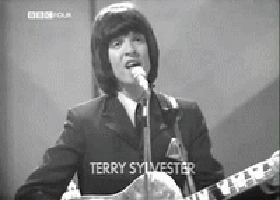
Although The Hollies' Terry Sylvester started off the show with a tune that most of the audience seemed unfamiliar with ("I Can't Let
Go"), he really got the crowd going with the hit "Bus Stop," followed by "Carrie Anne." Before he joined The Hollies in 1968 (replacing Graham Nash on the higher harmonies), Sylvester was a guitarist/vocalist with another British Invasion group, The Swinging Blue Jeans. It was great hearing him wail their hit single, "Hippy Hippy Shake" (#2 in the UK in late '63). He was a pleasant surprise and sounded really great! Here's classic footage of The Hollies performing "Carrie Anne," with Terry Sylvester playing guitar on the left.


-----------------------------------------------------------------------------------------------------------------------
Next in the lineup was another famous Liverpool musician, Mike Pender of The Searchers, and this guy was adorable! OK, maybe that's the wrong description because he really rocked
on guitar and his voice sounded fantastic, but his banter in between songs was, well, adorable. He had a great set of songs including "Sugar and Spice," "Don't Throw Your Love Away," "Love Potion No. 9," and "Needles and Pins" (even gave credit to Sonny Bono for writing that last one). All his famous guitar licks sounded spot-on on his beautiful Rickenbacker. Like The Hollies, Swinging Blue Jeans, Gerry & The Pacemakers, and The Beatles, The Searchers also emerged from the Merseybeat scene and have that distinct, jangly-guitar sound. It was great hearing it live! Here's The Searchers' remake of The Drifters' 1961 hit "Sweets For My Sweet," his lead-off tune on this tour.
------------------------------------------------------------------------------------------------------------------------

The third act of the night was the folk rock duo Chad & Jeremy, and these
talented blokes were hilarious!. They opened with the a cappella "You Are She," their last hit single from the '60s (or "we're going to sing this Acapulco for you," as Chad called it), but I can't for the life of me find the original recording (no thanks to YouTube and iTunes). But I was very impressed with their tight harmonies, and throughout the night, they even proved "they've still got it" with their guitar skills. They had the audience rolling with laughter as they told entertaining stories, even making fun of their appearances on American TV shows like Batman and The Dick Van Dyke Show. The backing band did join them on a few numbers like "Yesterdays Gone," "Willow Weep For Me," and "A Summer Song." I thoroughly enjoyed this guys. Here's classic footage of the duo's first hit single, 1964's "Yesterday's Gone" (arranged by film composer John Barry).

 ------------------------------------------------------------------------------------------------------------------------
After a brief intermission, another Liverpool lad was up next, Billy J. Kramer (originally with The Dakotas). While I most enjoyed the first half of the show, this part wasn't bad, but just not what I was expecting. Billy J. was a stud during the British Invasion, but I think he may of been having an off-night, plus I wasn't a fan of his current long hair. In the '60s, his manager was Brian Epstein (who also managed The Beatles), so Billy J. did give a nice tribute to Brian Epstein with his performance of a newer song called "To Liverpool With Love," and mentioned how he fought for Epstein to be inducted into the Rock and Roll Hall of Fame. Billy J. was friends with The Beatles, and he performed several of his hit songs written by Lennon-McCartney, including, "Bad To Me," I'll Keep You Satisfied," "From a Window," and "Do You Want to Know a Secret?" Here's a delightful 1964 performance of "Little Children," produced by George Martin; wasn't Billy J. a absolute doll back then?!
 ------------------------------------------------------------------------------------------------------------------------
For the final act of the night, Denny Laine of The Moody Blues concluded the show on a high note, killing on guitar and sounding great on vocals. Although likely unfamiliar to much of the audience, I was
pleasantly surprised by one his songs, "Say You Don't Mind," which became a hit when recorded in 1972 by Colin Blunstone (lead singer of The Zombies). Denny's set was surprisingly short but definitely sweet, finishing with The Moody Blues' first hit in 1964, "Go Now." After a standing ovation, the encore was a great "all hands on deck" rendition of Paul McCartney's "Band On The Run" (as Denny Laine was also a member of Wings with McCartney from '71-'81, this seems totally appropriate). So fun seeing all the musicians of the British Invasion tour having a blast together. Here's more great footage of Denny Laine leading The Moody Blues on "Go Now."

Thanks again to all these talented Brits for treating us to a great night!

Wednesday, September 7, 2011

Get Together

Flower Power: Part 3
Okay, I realize this next band might appear to have nothing to do with Flower Power but their unique sound seemed to greatly appeal to "flower children."
Formed in 1967 in San Francisco, Santana was a Latin rock band based around guitarist Carlos Santana, and have received a total of eight Grammy Awards over the years. After the group's first audition for a concert promoter, the promoter told them they would never make it in the San Francisco Music Scene playing Latin jazz fusion, and suggested to Carlos to keep his day-job. However, because their style contrasted with the other acts, the group gained public attention after performing at the Woodstock Festival in 1969. Immediately following the festival, Santana recorded their debut album, including their first hit single "Evil Ways." Reaching #9 on the charts, this song features Gregg Rolie on lead vocals and Hammond organ, and of course a notoriously-rockin' guitar solo by Carlos Santana.

-----------------------------------------------------------------------------------------------
Formed in 1964 in Ann Arbor, Michigan, The Arbors were a pop group consisting of two sets of brothers who met while attending college: Tom and Scott Herrick, and Ed and Fred Farran. After scoring a few minor hits in the '60s, they scored their biggest success with a 1969 easy listening version of "The Letter" that reached #20 on the charts (had been a hit two years prior for The Box Tops). After releasing one final album later that year, they began writing and playing music for commercials for the next 30 years. Although The Box Tops' recording of "The Letter" is a classic, I like The Arbors' version even better with its lush, string arrangement and its use of a great psychedelic effect (at the end) known as flanging. Seriously, turn this one up; it's surprisingly dramatic and beautiful (sorry no real video footage).

------------------------------------------------------------------------------------------------
A British Invasion band that's been featured a few times here at The '60s Beat, The Moody Blues definitely struck a chord with several audiences with their innovative fusion of rock and classical music. Having sold more than 70 million albums worldwide and been awarded 14 platinum and gold discs, the group continues to perform today with three original members from the '60s. Released as a single and featured on the album Days of Future Passed in November of 1967, "Nights in White Satin" reached #19 on the UK charts, however, it might have scored higher if it weren't for its over 7-minute length. After the success of other lengthy, dramatic songs like The Beatles' "Hey Jude" and Clapton's "Layla," The Moodies re-released this symphonic rock song in 1972 and it charted #2 on the U.S. Billboard chart and #1 in Canada. Written by lead singer Justin Hayward when he was 19, he literally titled the song after a friend gave him a gift of satin sheets. While the London Festival Orchestra performed the orchestral accompaniment in the intro and final sections, the "orchestral" sounds in the main body of the song were played by Mike Pinder's Mellotron (a keyboard device), which became known as the "Moody Blues sound."

-------------------------------------------------------------------------------------------------
Coming from the New York Greenwich Village folk scene in the mid-'60s, The Youngbloods were a folk rock band who unfortunately never achieved widespread popularity despite having received critical acclaim. Released in May of 1967, their folk rock single "Get Together" first peaked at #62, however, it received renewed interest after the song was used in a radio PSA as a call for brotherhood by the National Conference of Christians and Jews. Re-released in May of '69, it peaked at #5 on the charts, and since has been featured in several films. Written as an appeal for peace and brotherhood by Chet Powers in the early 1960s, the song was performed by several other artists before The Youngbloods including The Kingston Trio, We Five, Jefferson Airplane, and Judy Collins, followed by dozens of artists throughout the decades, but The Youngbloods' version remains the most-remembered today. Here's a live version from The Hollywood Palace.


Wednesday, April 20, 2011

"Catch Us If You Can"

British Invasion: Part 5
From Manchester, England, Wayne Fontana and The Mindbenders were a beat group that formed in 1963 like many other British Invasion bands. In April of 1965, they had their big break when "Game of Love" hit #1 on the US singles charts and #2 in the UK, which led to a tour of America. Unfortunately, after a few unsuccessful singles, Wayne Fontana left the group later that year (actually in the middle of a concert), and their guitarist Eric Stewart took over lead vocals. Then becoming just The Mindbenders, they released another chart-topper in 1965, "A Groovy Kind of Love." The video below is from another NME Poll Winners Concert performance with Wayne fronting The Mindbenders with the fun "Game of Love."

-----------------------------------------------------------------------------------------
Forming in 1964, The Troggs were a rock group from southern England, fronted by the raspy-voiced Reg Presley. With their chart-topper, signature hit "Wild Thing" (a tune included among the 500 Greatest Songs of All Time), the group is considered influential in the punk rock and garage rock genres that followed. In the summer of 1966, the group had another #1 UK hit with Reg Presley's "With a Girl Like You," which earned a gold disc after it sold over one million copies. However, their success in America was limited as they were not allowed to tour in the US until 1968. This live performance is likely another from the British NME Concert in 1966. I should probably be posting "Wild Thing," but here's "With a Girl Like You" instead, just because my husband happens to love this tune.

----------------------------------------------------------------------------------------------
In 1964, the rock band The Moody Blues formed in Birmingham, however, their early style and initial lead singer were different from the symphonic rock band that they evolved into in the late 1960's. In their early years, they began as a beat group with Denny Laine on lead vocals, and it was their second single, "Go Now," that launched their career in November 1964, becoming their only #1 UK hit to date. However, after some unsuccessful singles to follow, Denny Laine left the group (and later joined Paul McCartney in the 1970's group Wings) and Justin Hayward took over lead vocals. Even with the new lineup, the group continued to perform this song for awhile, and it would later be considered influential in the genre of prog rock with its lush instrumentation and strong baroque elements.

----------------------------------------------------------------------------------------------
Originating in North London in 1959, The Dave Clark Five were the second band during the British Invasion (after The Beatles) to perform on The Ed Sullivan Show in 1964, and become an even bigger success in the US than in their native country. With Dave Clark as the drummer and manager, this group was unique as they also included a saxophonist in the lineup. In 1965, the band released their own film, Catch Us If You Can (the US release titled Having a Wild Weekend), and the theme song of the same name became one of their top hits (I still have my dad's vinyl LP too!). Written by Dave Clark and guitarist Lenny Davidson, this song was quite 'catchy' as it begins with finger-snapping as the only accompaniment. As the group was promoted as having a 'cleaner' image than The Beatles, they were one of the first British Invasion groups to tour America, and appeared on The Ed Sullivan Show for a total of 18 times. This is just one of their many hit songs of the era.

Tuesday, March 22, 2011

Ruby TUESDAY Afternoon

Songs for Each Day of the Week: Day 3

Alright, so it's Tuesday, and oh boy, you're in for a real treat with two classic songs! First up, it's The Rolling Stones' "Ruby Tuesday," a double A-side single (backed with "Let's Spend the Night Together") that reached #1 on the U.S. charts after its January 1967 release. Written by guitarist Keith Richards about his girlfriend in the mid-1960's, this is another great tune included in the list of the 500 Greatest Songs of All Time. The talented Brian Jones played the recorder and piano, and the double bass was actually played jointly by bassist Bill Wyman and Keith Richards, with Wyman pressing the strings against the fingerboard and Richards bowing the strings. And in case you were wondering, yes, this song's title was the source of the restaurant chain of the same name. Here are the great Stones performing on The Ed Sullivan Show.

-----------------------------------------------------------------------------
The other classic song of the day is "Tuesday Afternoon" by the English symphonic rock band The Moody Blues. Initially titled "Forever Afternoon (Tuesday?)" and presented in two parts on their 1967 album Days of Future Passed, this dream pop/psychedelic pop song was edited down and re-released as the single "Tuesday Afternoon" in July of 1968. Featuring (the beautiful) Justin Hayward on lead vocals and acoustic guitar, he wrote this song while sitting in a field near his home in England one spring afternoon, and this song just came to him as he strummed his guitar. The backing melody comes from the mellotron (an early synthesized keyboard), played by Mike Pinder, and the short flute solo at the end is played by member Ray Thomas. Inspired by The Beatles' use of classical instrumentation, the album version of this song ends with a final orchestral rendition of the chorus, played by the London Festival Orchestra. Although this performance is not without its pitch problems as it is not an easy song to perform live, there's still something special about seeing this classic footage of the "Moodies."