

All ready to go in my Union Jack attire, complete with vinyl record purse (which drew quite a bit of attention; a few people even asked to take a picture of it!).

The night was really enhanced by the great mix of classic footage and live feed of each musician projected on the large screens on both sides of the stage. My seat was initially much further back but I was upgraded when a nice lady handed me an extra ticket!

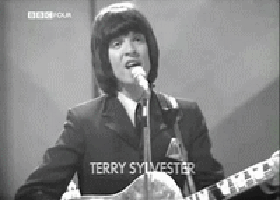
 Go"), he really got the crowd going with the hit "Bus Stop," followed by "Carrie Anne." Before he joined The Hollies in 1968 (replacing Graham Nash on the higher harmonies), Sylvester was a guitarist/vocalist with another British Invasion group, The Swinging Blue Jeans. It was great hearing him wail their hit single, "Hippy Hippy Shake" (#2 in the UK in late '63). He was a pleasant surprise and sounded really great! Here's classic footage of The Hollies performing "Carrie Anne," with Terry Sylvester playing guitar on the left.
-----------------------------------------------------------------------------------------------------------------------

 on guitar and his voice sounded fantastic, but his banter in between songs was, well, adorable. He had a great set of songs including "Sugar and Spice," "Don't Throw Your Love Away," "Love Potion No. 9," and "Needles and Pins" (even gave credit to Sonny Bono for writing that last one). All his famous guitar licks sounded spot-on on his beautiful Rickenbacker. Like The Hollies, Swinging Blue Jeans, Gerry & The Pacemakers, and The Beatles, The Searchers also emerged from the Merseybeat scene and have that distinct, jangly-guitar sound. It was great hearing it live! Here's The Searchers' remake of The Drifters' 1961 hit "Sweets For My Sweet," his lead-off tune on this tour.
The third act of the night was the folk rock duo Chad & Jeremy, and these
 talented blokes were hilarious!. They opened with the a cappella "You Are She," their last hit single from the '60s (or "we're going to sing this Acapulco for you," as Chad called it), but I can't for the life of me find the original recording (no thanks to YouTube and iTunes). But I was very impressed with their tight harmonies, and throughout the night, they even proved "they've still got it" with their guitar skills. They had the audience rolling with laughter as they told entertaining stories, even making fun of their appearances on American TV shows like Batman and The Dick Van Dyke Show. The backing band did join them on a few numbers like "Yesterdays Gone," "Willow Weep For Me," and "A Summer Song." I thoroughly enjoyed this guys. Here's classic footage of the duo's first hit single, 1964's "Yesterday's Gone" (arranged by film composer John Barry).
------------------------------------------------------------------------------------------------------------------------

 After a brief intermission, another Liverpool lad was up next, Billy J. Kramer (originally with The Dakotas). While I most enjoyed the first half of the show, this part wasn't bad, but just not what I was expecting. Billy J. was a stud during the British Invasion, but I think he may of been having an off-night, plus I wasn't a fan of his current long hair. In the '60s, his manager was Brian Epstein (who also managed The Beatles), so Billy J. did give a nice tribute to Brian Epstein with his performance of a newer song called "To Liverpool With Love," and mentioned how he fought for Epstein to be inducted into the Rock and Roll Hall of Fame. Billy J. was friends with The Beatles, and he performed several of his hit songs written by Lennon-McCartney, including, "Bad To Me," I'll Keep You Satisfied," "From a Window," and "Do You Want to Know a Secret?" Here's a delightful 1964 performance of "Little Children," produced by George Martin; wasn't Billy J. a absolute doll back then?!
 pleasantly surprised by one his songs, "Say You Don't Mind," which became a hit when recorded in 1972 by Colin Blunstone (lead singer of The Zombies). Denny's set was surprisingly short but definitely sweet, finishing with The Moody Blues' first hit in 1964, "Go Now." After a standing ovation, the encore was a great "all hands on deck" rendition of Paul McCartney's "Band On The Run" (as Denny Laine was also a member of Wings with McCartney from '71-'81, this seems totally appropriate). So fun seeing all the musicians of the British Invasion tour having a blast together. Here's more great footage of Denny Laine leading The Moody Blues on "Go Now."
Thanks again to all these talented Brits for treating us to a great night!


