Showing posts with label Peter Paul and Mary. Show all posts

Sunday, September 30, 2012

If I Had a Hammer

Protest Songs/Message Music: Part 3

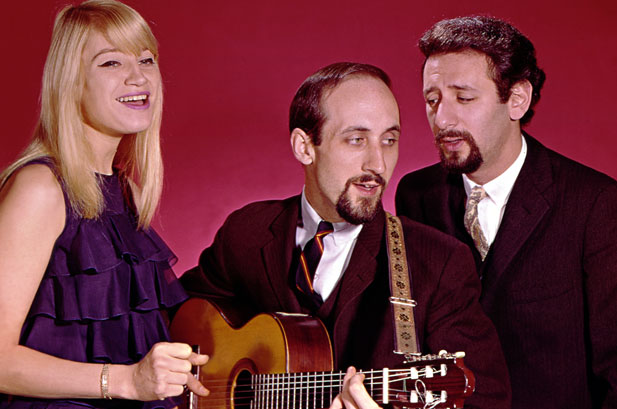
A paradigm for 1960s folk music, Peter, Paul & Mary were known for their prolific political activism involving the peace movement and other causes. Written by Pete Seeger (an iconic figure in the folk music revival) and Lee Hayes in support of the progressive moment in 1949, "If I Had a Hammer" was first recorded by their group The Weavers, who inspired the "folk boom" that followed in the early '60s. The folk song was not much of a success until Peter, Paul & Mary recorded it over a decade later in 1962 for their debut album. Released that August, "The Hammer Song" became a Top-10 hit and became an anthem for the Civil Rights movement. The trio even performed it at the 1963 March on Washington, which also featured fellow folk musician Bob Dylan (from this post), as well as Martin Luther King Jr's infamous speech. Here's an excellent TV performance of this timeless classic.
 -----------------------------------------------------------------------------------------------------------------
 Our next emotional civil rights-themed ballad comes from British Invasion group The Hollies. Written by Bob Russell (who was dying of cancer at the time) and Bobby Scott, "He Ain't Heavy, He's My Brother" used the old motto for Boys Town for its title, and it was reported at the time that song was about a Vietnam veteran. This vet saw a little boy carrying the dead body of a younger boy away from a burning village, and when asked if the body was heavy, he replied: "He's not heavy, he's my brothers." This statement is a figure of speech (known as a paraprosdokian) in which the second half of the statement causes the hearer to reinterpret the first part. Released in September 1969, this moving tune reached #7 in the US and #3 in the UK, where it was also re-released in 1988 (paired with "Carrie Anne"), reaching #1 after its use in a commercial. While the studio recording features a young Elton John on piano, here's a powerful performance by The Hollies and lead singer Allan Clarke (with introduction by famous radio DJ Kasey Kasem). Now this is beautiful songwriting!
--------------------------------------------------------------------------------------------------------------------------
Our next 1960s era anti-war song comes from Canadian folk-pop group Original Caste who were known for their rich, tight vocals and clean sound. Written by group members Dennis Lambert and Brian Potter, the 1969 song "One Tin Soldier" was a #1 hit in Canada and managed to reach #34 in the US. Telling an abstract story of a hidden treasure and two neighboring peoples, the lyrics are a parable condemning prejudice and greed. The song was revived in the 1971 when a version by Jinx Dawson and her band Coven was featured in the soundtrack for the film Billy Jack, hitting the charts in 1973 and again '74 after the end of the Vietnam War, and was named the Number One All Time Requested Song of '71 and '73 by American Radio Broadcasters Association. With the beautiful vocals of Dixie Lee Innes, here's a live performance recording (audio only) of the initial group Original Caste.
--------------------------------------------------------------------------------------------------------------------
Our final tune comes from folk/pop group The Kingston Trio, one of the most prominent bands in the revival of folk music in the late 1950s to the late 1960s. Beginning as a San Francisco Bay area nightclub act, the trio released 19 albums that made the Top-100, 14 of which were ranked in the Top-10, and 5 of those hit the #1 spot. One of the group's most successful singles was "Where Have All the Flowers Gone?" which reached #21 on the US chart in the 1962. The first three verses were written by Pete Seeger in 1955, and the additional verses were added by Joe Hickerson in 1960, who turned it into a circular song (about the cycle of history and how impossible it is to break). Gaining wider meaning during the Vietnam War, it later has been listed as the "Top 20 Political Songs" (by New Statesmen). Here's a 1966 performance by The Kingston Trio on The Andy Williams Show (R.I.P. Mr. Williams!).

Wednesday, May 23, 2012

Song of the Day: Leaving On A Jet Plane

Since I'm about to be leaving on a jet plane, you can take a wild guess as to which tune is the featured Song of the Day. Unlike these lyrics, I thankfully know when I'm coming back, but the posting will be a little quiet for just a week or two. Written by folk singer John Denver, "Leaving On A Jet Plane" was originally recorded in 1967 by the Chad Mitchell Trio (of which the then unknown Denver had replaced Mitchell two years prior), and later that year, this song was always recorded by Spanky & Our Gang (which I really wanted to post their version too but it's not on YouTube). Peter, Paul, & Mary also released a version on their album that same year, but it didn't become a big hit until they released it as a single in 1969. For this famous folk trio, it turned out to be their biggest (and final) hit, becoming their only #1 hit on the US Billboard chart. It also topped the easy listening chart for three weeks. In the late '70s, the song was used in United Airlines commercials. Here's a live performance by Peter, Paul, & Mary in Melbourne, Australia in 1968 (the sound quality is a not so great at the beginning but does improve for the rest of the song).   
 

John Denver later went on to have a successful solo career and was one of the most popular acoustic acts in the 1970s. Here's also another live version featuring Denver and Cass Elliot (of The Mamas & The Papas) on The Midnight Special in the early '70s. Their voices blend really well in this lovely tune. (And no jokes now about the fact that Denver died while flying his personal plane in the late '90s).


Wow, sorry to end on such a melancholy note, but I'm be back soon.

Thursday, July 21, 2011

Those Darn Kids and Their Music

Banned Songs: Part 1
So how about a three-part segment of songs that were either banned or edited for the radio due to questionable lyrics?!
For anyone that knows a little about The Beatles, they probably can guess a few of their tunes were banned including "A Day in the Life" (for lyrics about a graphic car accident) and "Lucy in the Sky with Diamonds" (which was thought to be a drug reference, however, it was based upon drawing by John Lennon's son). "I Am the Walrus" was another of those banned songs, although it's quite clear what substance contributed to some of these lyrics. Released in November 1967 as the B-side to "Hello, Goodbye," Lennon composed this psychedelic rock song by combining three songs he had been working on. He also added a verse of nonsensical words when he had a learned that a teacher at his old primary school was having students analyze his lyrics. The walrus is a reference to Lewis Carroll's "Walrus and the Carpenter" (from the sequel to Alice In Wonderland), however, Lennon was 'bummed' when he later learned that the walrus was the 'bad guy.' From their 1967 TV film Magical Mystery Tour, here's a Beatles tune banned by the BCC for a couple of inappropriate lines.

------------------------------------------------------------------------------------------------
And here's Peter, Paul, and Mary, the beloved folk group just discussed a few posts ago. Although they were often politically outspoken in their lyrics, their only song to actually be banned was "Puff, the Magic Dragon," a simple song about the loss of childhood innocence. Based upon a 1959 poem written by 19-year-old Cornell student Leonard Lipton, an acquaintance of Peter Yarrow (of the trio), Lipton was given half of the songwriting credits along with Yarrow after the song's release in 1963. Throughout the sixties, there was lots of speculation about the lyrics referring drugs leading to its ban in several countries, but the authors consistently deny this rumor. Since, this song is considered a popular children's classic, and has become a part of American and British pop culture.

------------------------------------------------------------------------------------------------
From Portland, Oregon, The Kingsmen were a garage rock band best known for their 1963 recording of Richard Berry's "Louie Louie." It held the #2 spot on the Billboard chart for six weeks and is still well-known today. However, because of lead singer/rhythm guitarist Jack Ely's indistinguishable enunciation of the lyrics (try saying that ten times fast!), the song became immediately controversial, with millions of teenagers and their parents thinking it was "dirty." As a result, the governor of Illinois banned it, and the FBI even got involved investigating the lyrics, but found nothing. The words are, in fact, innocent, which you can actually hear a bit clearer in this video footage from Shindig! compared to the garbled vocals on the original recording.

------------------------------------------------------------------------------------------------
Finally, we all know that The Rolling Stones were the 'bad boys' of the British Invasion as their music was often quite suggestive. Written by Mick Jagger and Keith Richards, "Let's Spend the Night Together" was released as a double A-sided single with "Ruby Tuesday" in January 1967, and was definitely controversial at the time. On the Ed Sullivan Show, the band was initially not allowed to perform this song, but a compromise was met by changing the lyrics to "let's spend some time together." However, during the live performance, Jagger clearly rolled his eyes at the TV camera every time he sang that line (seen in this footage below). This, combined with their antics backstage (something about wearing Nazi uniforms), Ed Sullivan announced the band was banned for performing on the show again.

Thursday, July 14, 2011

Folk For A Day

After mentioning folk singer Joan Baez in the recent Patriotic post, I realized I should devote a day to some of the other folk folks of the 1960s. This post is definitely on the mellow side but folk music was very significant to this decade as a social, cultural, and political force.

American singer-songwriter Bob Dylan was first introduced during Folk Rock Week at The '60s Beat, when he "went electric" and influenced the sound of the '60s, even impacting the music of The Beatles. With a recording career spanning fifty years, he has explored various genres including folk, blues, country, gospel, rock 'n roll, rockabilly, even English, Scottish, and Irish folk music. Before he became known for his political, social, philosophical, and literary influence, Dylan's humble beginnings were that of a young (Jewish) folk musician from Minnesota, initially inspired by the songs of Woody Guthrie and Hank Williams, and the performance style of Buddy Holly. Released in August 1963, "Blowin' In The Wind" was described as a protest song, although it raises several questions about peace, war, and freedom, and since has been ranked #15 of the 500 Greatest Songs of All Time. With a voice sometimes as surprising as his lyrics, Dylan would go on to become one of the most influential figures (musically and culturally) of the 20th century. Here's a great quality, live performance in 1963.

------------------------------------------------------------------------------------------------
Interestingly, Dylan's "Blowin' In The Wind" was covered by another folk group and released just three weeks before his, however, this version became an international hit (listen here). The American folk-singing trio, Peter, Paul & Mary, were one of the biggest musical acts of the 1960s. After auditioning for manager Albert Grossman in 1961, Peter Yarrow, Paul Stookey, and Mary Travers were chosen from the New York folk scene, becoming a successful and beloved group that helped revive folk music in America (which had been forced underground by McCarthyism in the late '50s). As folk music goes hand-in-hand with promoting peace, they performed "The Hammer Song" at the 1963 March on Washington, best remembered for Martin Luther King Jr.'s "I Have a Dream" speech. As "Blowin' In The Wind" was one of their biggest hits, they sang other Dylan songs like "Don't Think Twice, It's All Right," which aided in the popularity of his second album. I'm sure you were expecting to hear one of their biggest hits, but I really love the group's rendition of this folk beauty. Initially released by the trio in 1963, here's a live performance of "Don't Think Twice" in Sydney while on their Australian tour in the late '60s.

------------------------------------------------------------------------------------------------
Described as one of the most important female recording artists of the rock era, Canadian singer-songwriter Joni Mitchell was known for her distinctive voice and unique guitar style, as well as complex piano arrangements further into her career. First achieving fame as a songwriter in New York, then as singer with her debut album in 1968, she finally settled in Southern California (introduced to the L.A. music scene by David Crosby of The Byrds) and played a significant part in the development of rock folk. Her success really took off in the early 1970s, beginning with a Grammy Award win for Best Folk Performance for her album Clouds in March 1970, the first of many wins over the years. The following month, Mitchell's next album featured the folk rock tune "Big Yellow Taxi," a big hit in her native Canada that has since been voted #9 on CBC's list of the 50 essential Canadian tracks. Known for its environmental concern, this song is one of the most identifiable of Mitchell's music.

------------------------------------------------------------------------------------------------
One of Joni Mitchell's most famous songs was made famous by fellow folk musician Judy Collins. An American singer and songwriter, Collins was inspired by the folk music revival in the early 1960s and began her career in the Greenwich Village folk music scene in New York City as well. She is known for recording a wide variety of other genres including folk, show tunes, pop, rock 'n' roll, and standards, as well as for her social activism (like most folk singers of the time). After signing with a record label in 1961 at the age of 22, Collins has continued a steady career of recording and performing, still touring today. Written by Joni Mitchell, Collins released "Both Sides Now" in 1968, which reached #8 on the Billboard charts and won her a Grammy Award for Best Folk Performance of that year. It has since become her signature song and is ranked among those 500 Greatest Songs of All Time. I was unable to find a live performance of this song from the '60s, so here's Judy Collins performing this beauty with the Boston Pops in 1976.

-----------------------------------------------------------------------------------------------
And we'll conclude with good 'ol Donovan, one of the leading British recording artists of his day who produced a series of hit singles and albums between 1965 and 1970. The Scottish singer-songwriter and guitarist is remembered for having developed a distinctive style, mixing folk, jazz, pop, psychedelic, and world music together. Since we've explored some of those "evolved sounds of Donovan" in past posts, we'll go back to his roots with his early folk sound, a time when he was even referred to as the "British Bob Dylan." Released in 1965, "Catch the Wind" was his first single, reaching #4 on the UK charts and #23 in the US. The single version featured Donovan's voice with an echo and strings, while the song was re-recorded for his first album without the vocal echo and string section. Here's a live performance of classic Donovan on the American TV show Shindig!.