On May 20th, we lost one of the greatest rock keyboardists of all time, Ray Manzarek, who passed away at the age of 74 due to cancer. As a founding member and rock organist with The Doors, Manzarek contributed greatly to one of the most influential and revolutionary groups of the 1960s. Manzarek initially met poet Jim Morrison in film school at UCLA, and after running into each other again after graduation, they almost immediately formed The Doors. The group lacked a bass player, so Manzarek usually covered the bass parts on keyboard. His signature sound is that of the Vox Continental combo organ, an instrument used by many other psychedelic rock groups of that era. As a classically-trained pianist, he was instrumental in expanding upon songs of the The Doors, creating distinctive organ intros like that in "Light My Fire" (inspired by Bach's Two and Three-Part Invensions).
From their debut album in 1967, this #1 hit has been featured before during our Psychedelic Rock Week (here), but we're posting it again because it's just that good. While the single version was edited down to just under 3 minutes with nearly all the instrumental break removed for radio airplay, this live performance at the Hollywood Bowl in 1968 includes the album's 7-minute version. No mistaking that opening sound of Manzarek on his rock organ.
Carrying over their psychedelic rock and blues rock sound into the 1970s, "Love Her Madly" reached #11 on the Billboard chart in 1971, and features Manzarek playing both tack piano and his signature Continental Vox in the recording. Not an actual live performance but nicely done audio and video compilation.
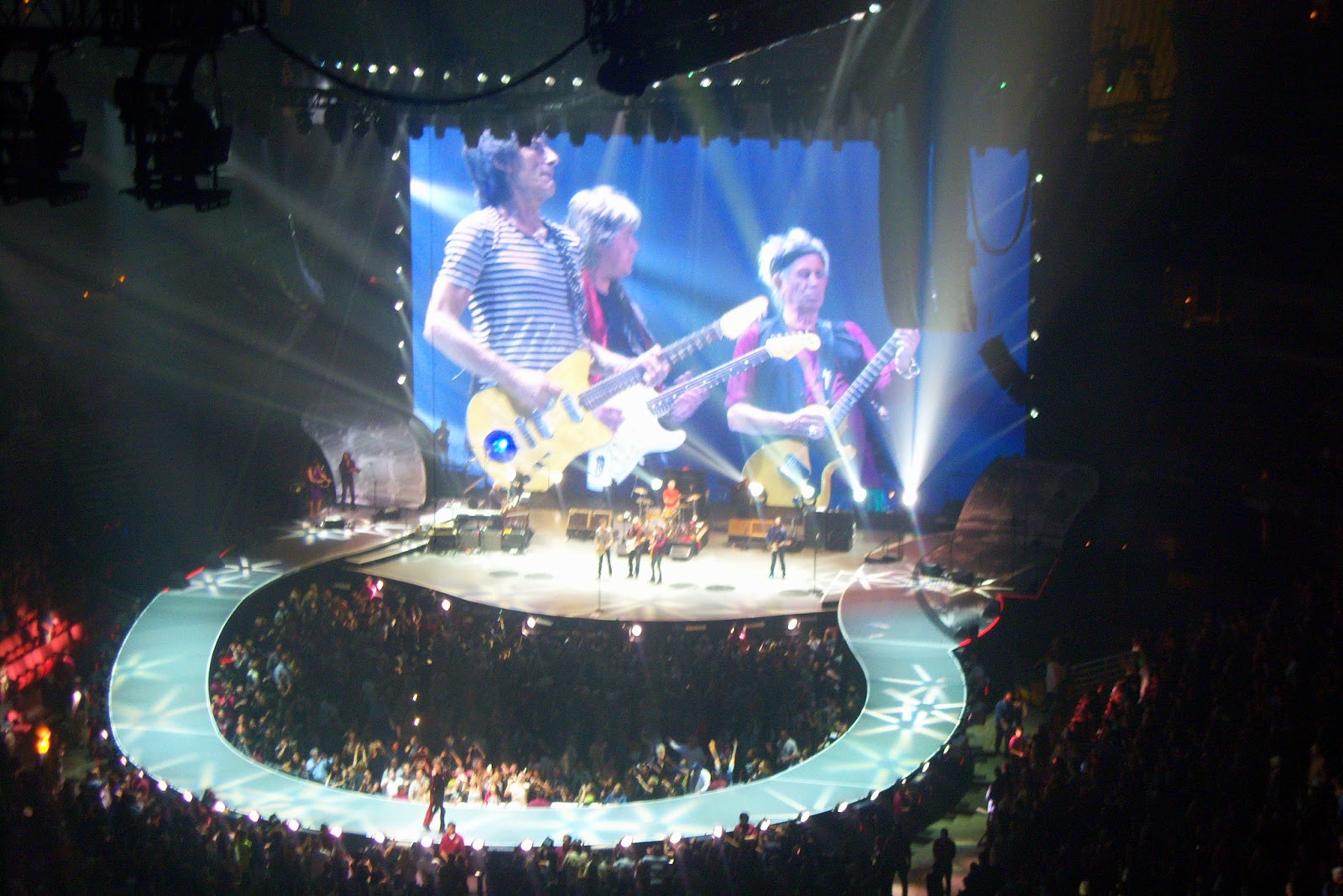
On Saturday, May 18th, a friend and I checked off a box on our bucket-list: attend a Rolling Stones concert! The Stones are some of the oldest rockers out there, but they are still going strong after fifty years since they first formed. As part of their ongoing 50 & Counting Tour, these Brits put on an awesome show at the Honda Center ("The Pond") in Anaheim, CA, and there's nothing like seeing their incredible energy and impressive talent in person! The arena took quite awhile to fill up, giving us ample time for people-watching (the audience was also a sight to behold), but once the concert began 50 minutes late, it was a near full house and we were in for a treat with over two hours of solid music. High-energy Mick Jagger belted on vocals, jammed on harmonica, and strutted on the catwalk around the tongue pit. Keith Richards and Ronnie Wood (member since 1975) both wailed on guitar, and Charlie Watts (also a founding member with Jagger and Richards) rocked out on drums. No wonder these guys are so skinny! Their support musicians were also excellent and a great addition, including two backup singers, keyboardist, bass player, and sax players They performed over 20 hits from throughout their lengthy career, including "Get Off of My Cloud," "Paint It Black," "Gimme Shelter," "Wild Horses," "Honky Tonk Women," "Start Me Up," "Brown Sugar," and 3-song encore with "You Can't Always Get What You Want," "Jumpin' Jack Flash," and "(I Can't Get No) Satisfaction." One of the top guitarists of all time, Mick Taylor (Stones member from '69-'74), was a featured guest, joining the band on "Midnight Rambler," and Dave Grohl of Foo Fighters (and Nirvana) also made a guest appearance on guitar. With the exception of the massive pot-smoke that enveloped us during the performance, it was a stellar show! Here we are, ready to rock to out!
The stage incorporating their infamous lips and tongue logo.
You can see Jagger out front on the catwalk (don't laugh at my faraway seat, but the only way I'd pay the $600 for the good seats is if it included the time machine to see The Stones back in the '60s!).
And because it wouldn't be the '60s Beat without a performance from back in the day, here's the classic tune The Stones opened the concert with. Written as a reaction to their sudden popularity after the success of "Satisfaction" in 1965, "Get Off of My Cloud" topped the charts in the US and UK in November of 1965. Cultivating their infamous "bad boy" image, the lyrics are defiant and rebellious, a common practice for The Stones around that time.
And for the first part of the concert's encore, The Stones performed "You Can't Always Get What You Want," featuring a full choir and French horn player. Written by Jagger and Richards and released in July of 1969, it was named the 100th greatest song of all time by Rolling Stone magazine in its 2004 list. The three verses (along with the varied theme in the fourth verse) address the major topics of the 1960s: love, politics, and drugs. Each verse captures the essence of the initial optimism and eventual disillusion, resigning to a practical approach in the chorus. Minus the choral introduction, here's a performance on The David Frost Show in 1969 (live vocals only).
Happy 50th Anniversary to The Rolling Stones, and thank you for a night to remember!
We're not finished with our Wrecking Crew Series, but because I'm thinking of my Marine husband who is currently in Afghanistan, we're doing a jam-packed post featuring the biggest instrumental hits of the 1960s. So yes, my hubby loves this stuff, and yes, we were both born in the wrong generation!
One of the most successful instrumental groups of the decade was Herb Alpert & The Tijuana Brass from L.A. As trumpeter, music producer, and record executive, Alpert first found success in 1962 with his Latin-styled hit "The Lonely Bull, however, The Tijuana Brass was just Alpert overdubbing his own trumpet slightly out of sync. By the end of 1964, because of a growing demand for live performances by the Tijuana Brass, Alpert auditioned and hired a team of top session musicians (including members of The Wrecking Crew of course!). The band debuted in 1965 and became one of the highest-paid acts then performing, having put together a complete revue that included choreographed moves and comic routines. An instrumental track originally written for the 1960 Broadway show of the same name (and 1961 film), Alpert's version of "A Taste of Honey" was the most popular, spending five weeks at #1 on the Easy Listening chart, reaching #7 on the Hot 100, and won three awards including Record of the Year at the 1966 Grammy Awards. My husband has a ton of their records!
Canadian bandleader, orchestrator, composer and conductor Percy Faith was known for his lush arrangements of pop and Christmas standards, and is often credited for popularizing the "easy listening" or "mood music" format. One of his most memorable recordings is "Theme from A Summer Place" (1960), which earned him the Record of the Year Grammy Award in 1961, and is the longest-running #1 instrumental in the history of the Billboard chart (9 weeks). Faith remains the only artist to have a best-selling single of the year during both the pop singer era ("Song from Moulin Rouge") and the rock era ("Theme from A Summer Place"), and he is one of only three artists (with Elvis and The Beatles) to have the best-selling single of the year twice. Here's a fantastic live performance of Percy Faith conducting his musical magic.
American guitarist and composer Mason Williams was a comedy writer for Smothers Brothers Comedy Hour, The Glen Campbell Goodtime Hour, and Saturday Night Live, however, he was best-known for his guitar instrumental hit, "Classical Gas." Composed and originally performed by Mason in 1968, this record earned three Grammy Awards including Best Musical Composition, Best Comtemporary-Pop Performance - Instrumental, and Best Instrumental Orchestra Arrangement (for arranger Mike Post, who went on to write dozens of TV shows themes including Law & Order and Magnum P.I.). Selling over a million copies and earning a gold disc, it peaked at #2 on the charts for two weeks. My husband loves this one (although we think the rest of the LP is odd) and even made his own successful arrangement for symphonic band back in high school. Here's Mason Williams with a good-lookin' orchestra (miming the studio recording) on the Ed Sullivan Show in March of '68.
The Tornados were an English instrumental group that acted as a backing band for many of record producer Joe Meek's productions and also for singer Billy Fury. Enjoying several chart hits in their own right, their biggest success was the instrumental single "Telstar." Released in August of 1962, this surf rock-sounding record was named after the Telstar communications satellite that was launched into space just a month prior, and reached #1 in both the UK and US (the first US #1 single by a British group). Featuring a clavioline (a keyboard instrument with a distinctive electronic sound), it became a precursor to space rock intending to evoke the dawn of the space age. Unfortunately, pop instrumentals lost popularity with British audiences when the "Mersey Sound" (i.e. The Beatles) became more and more popular in 1963.
French orchestra leader Paul Mauriat specialized in the easy listening genre, and is best known in the US for his million-selling remake of Andre' Popp's "Love is Blue." In February of 1968, this version hit #1 on the US pop charts, becoming the only performance by a French artist ever to top the Billboard Hot 100. Its five-week run at the top was the second longest of any instrumental on the pop chart era next to "Theme from A Summer Place," of course. It also spent 11 weeks at #1 on the easy listening charts, and peaked at #12 on the UK Singles chart. In case you're curious about the original version, you can see Greek singer Vicky Leandros singing the original French lyrics in the Eurovision Song Contest of 1967 here. This instrumental beauty still crops up on film and TV, including most recently on an episode of the popular '60s-based drama Mad Men. Here's a live performance from a few decades after its success.
The Brass Ring was a group of American studio musicians led by saxophonist and arranger Phil Bodner. They were based in New York City and were stylistically similar to Herb Alpert and other "Now Sound" instrumental pop groups from the 1960s, although the twin-sax sound more closely resembled Billy Vaughn, who had big hits in the '50s (I even have some of my grandparents' Billy Vaughn records!). The group had two hit singles, including "The Dis-Advantages of You," which was used in a commercial for Henson & Hodges (cigarettes) and hit #36 on the Billboard chart in 1966. I can't explain it but my hubby just loves this stuff, and we own at least three Brass Ring albums. We're so weird!
I'll conclude this fabulously full post with the Dave Brubeck Quartet, an American jazz group considered to be one of the foremost exponents of cool jazz. Their best-remembered piece is the enduring jazz classic, "Take Five," composed by the quartet's saxophonist Paul Desmond. While its not the first jazz composition to use quintuple meter (5/4 time), it was the first in the US to achieve mainstream significance, reaching #25 on the Billboard Hot 100 and #5 on the easy listening chart in 1961, two years after its initial release. For several years in the early '60s, it was the theme music for NBC "Today" program, and has been included in countless movie and TV soundtracks. With the distinctive, catchy saxophone melody, here's an excellent live performance of "Take Five" by the Dave Brubeck Quartet.
Three legendary artists have passed away in recent weeks. American actress and singer Annette Funicello passed away on April 8th, 2013 at the age of 70, due to complications from her multiple sclerosis. She began her career as a child performer at the age of 12 and rose to prominence as one of the most popular "Mouseketeers" on the original Mickey Mouse Club. She later established herself as a film actress, popularizing the successful "Beach Party" genre with co-star Frankie Avalon during the mid-1960s. From a typical, teenage movie, here's sweet Annette singing the title theme to 1965's "The Monkey's Uncle," backed by...wait for it...The Beach Boys? Yep. It's actually kind of cute.
On April 22nd, American singer-songwriter guitarist Richie Havens died of a heart attack at the age of 72. He is best known for his intense and rhythmic guitar style (often in open tunings), soulful covers of pop and folk songs, and his opening performance at the 1969 Woodstock Festival. During this infamous performance, Havens held the crowd for nearly three hours (in part because he was told to
perform a lengthy set because many artists were delayed in reaching the
festival location), and he was called back for several encores. Having
run out of tunes, he improvised a song based on the old spiritual,
"Motherless Child," that became "Freedom" (as seen in his video clip from the festival). Only a true musician can bring this much passion to an improvised song.
And today, April 26th, we lost American country music singer George Jones who passed away at 81 years old. Beginning his career in 1954, he is remembered for his long list of hit records, his distinctive voice and phrasing, and his marriage to country singer Tammy Wynette. The flat-topped singer (also known for his hard-living lifestyle) placed multiple singles on the country charts each year during the '60s, including ballads like "Walk Through This World with Me." Released in January 1967, this single was his 57th release on the country chart and his fourth #1 hit.
Alright, it's about time I get back to writin' and continuing our fabulous series on the Wrecking Crew musicians (which is not even close to over)! First off, we're featuring American country music singer Glen Campbell, who was actually a regular guitarist amongst the first-call "Wrecking Crew" studio musicians before embarking on a highly successful solo career (something like releasing over 70 albums and selling over 45 million records, no biggie). In the mid-60s, he filled in for Brian Wilson as a touring musician on Beach Boys tours, and played guitar on the revolutionary Pet Sounds album. After the success of "Wichita Lineman" (featured here during the Country Crossovers series), Campbell scored a big hit with another Jimmy Webb song, "Galveston," which reached #4 on the Billboard charts and #1 on the country chart. Although it's widely considered an anti-Vietnam protest song, Campbell (a Republican) performed it up-tempo, conveying a more general message in a patriotic way, and it's considered the official anthem of Galveston, Texas. Other Wrecking Crew musicians included in this recording are Hal Blaine on drums (as usual), Al Casey on acoustic guitar, and Joe Osborn on bass. Here's a live performance of "Galveston" (with a studio backing track) on Campbell's own series The Glen Campbell Goodtime Hour.
Joining the likes of The Beach Boys as vocal "surf music" pioneers, Los Angeles duo Jan & Dean used the Wrecking Crew musicians on their recordings too, and found peak success during the surf rock craze just prior to the British Invasion. Amongst their biggest songs like "Surf City" (featured way back here) and "Dead Man's Curve" was their #3 hit "Little Old Lady from Pasadena" released in June 1964. Based on a folk archetype of the widowed ladies in this East L.A. city, this comic song's twist was that not only did this little old lady drive a hot car, she was also a street racer. The top-notch WC musicians used on this recording are drummers Hal Blaine and Earl Palmer, pianist Leon Russell, guitarists Tommy Tedesco, Billy Strange, and Bill Pitman, and bassist Jimmy Bond, among a few others. The coolest part is that I found out this recording's personnel by looking at copies of actual contracts provided online by the Musician's Union (American Federation of Musicians; my husband was in that same union back in his professional musician days). You can check out some of these contracts for these legendary recording sessions on the official Wrecking Crew website here. Anyway, introduced by singer Lesley Gore, here's a live vocal performance by Jan & Dean.
You've probably heard of the popular New York girl group The Crystals (pictured left) who released huge hits in the early 1960s like "Da Doo Ron Ron" and "Then He Kissed Me." But you may not know that their most-enduring success, "He's a Rebel," was only credited to The Crystals but was actually recorded by singer Darlene Love and her backing group The Blossoms (pictured right). Legend has it that when the real Crystals were unable to travel fast enough to L.A. from New York to record "He's a Rebel" (written by singer Gene Pitney), record producer Phil Spector had Love and her L.A.-based group record the single under the banner of The Crystals. The real Crystals had to add the song to their live repertoire, even though lead singer Barbara Alston's soft voice could not mimic Love's hearty deliver. While The Crystals are considered one of the defining acts of the girl group era of the first half of the '60s, this recording is among the 500 Greatest Songs of All Time and is considered one of the definitive examples of the Spector-produced girl group sound. Including all WC musicians on this song, here's a lip-synced performance by The Crystals of the original recording.
While the Wrecking Crew may have its origins with studio musicians dating back to the late 1950s, the Crew was definitely at work with hits in the early '60s, playing for stars like the King of Soul himself, Sam Cooke. With his distinctive vocal abilities, Cooke's "Twistin' the Night Away" is among his most popular songs, reaching #9 on the pop charts and #1 on the R&B chart after its release in January 1962. Written by Cooke, it was even successful overseas as well, reaching #6 in the UK. The recording includes WC members Tommy Tedesco and Clifton White on guitar, and Earl Palmer on drums, as well as a swingin' horn section. Haven't figured where this footage comes from, but here's a great performance by the extremely talented Sam Cooke with a live band in December 1963 (one year before his untimely death).
The WC didn't just play rock 'n' roll of the '60s but were also used for traditional pop standard recordings as well, like Wayne Newton's "Danke Schoen." First composed and recorded by Bert Kaempfert, the song was originally intended for singer Bobby Darin as a follow-up to "Mack the Knife." However, after seeing a 21-year-old Newton perform at the Copacabana, he decided to give it to Newton and transposed the key of the recording to fit Newton's high tenor voice (sometimes mistaken for a female!). Released in 1963, this recording reached #13 on the Billboard pop charts and #3 on the easy listening chart, becoming Newton's signature song. Before becoming one of the biggest (and longest-running) performers in Las Vegas, here's a very polished live performance by the young, self-assured Wayne Newton in 1968.
As we continue with more songs backed by the fabulous Wrecking Crew session musicians, this next one was a transatlantic hit and a signature song for singer/actress Nancy Sinatra (yes, daughter of that famous crooner Frankie). Written by Lee Hazelwood (who wrote and produced most of her hits), "These Boots Are Made for Walkin'" reached #1 on the US and UK charts after its release in February 1966. Arranger and conductor (also WC guitarist) Billy Strange used two basses together, Carol Kaye on electric bass and Chuck Berghofer on double bass, to provide the notable bass line (Ms. Kaye, pictured on the right, played on almost all hit records out of L.A. at that time and was the only woman in the Wrecking Crew). The session also included Hal Blaine on drums (as usual), and Al Casey, Tommy Tedesco, and Strange on guitars, along many others. During TV news coverage in '66/'67, this song was aired as soundtrack as a camera focused on US infantrymen on patrol in the Vietnam, and around that same time, Sinatra herself traveled to South Vietnam to perform for the troops. Here's the promo video featuring Nancy Sinatra's trademark look, synonymous with go-go boots.
Herb Alpert & The Tijuana Brass could have been named Herb Alpert
& The Wrecking Crew. Yep, trumpeter Alpert needed a team of crack
session musicians and used the WC members to record his music, including five #1 hit albums in the 1960s. Released the same year (and equally as popular)
as Whipped Cream and Other Delights, their second 1965 album, Going Places, included enduring tunes like "Tijuana Taxi" and "Spanish Flea." Reaching #1 on the US chart, "Spanish Flea"
was composed by Alpert's friend and mariachi band leader, Julius
Wechter, who also played percussion and marimba with the Wrecking Crew
musicians (he also went on to form the Baja Marimba Band, at Alpert's
encouragement). Featuring Alpert's trumpeting over a Latin rhythm backing, this instrumental song was used as "The Bachelor's Theme" for the long-running TV show The Dating Game (my dad was on that show in the '70s!). Using his touring band, here's excellent TV footage of Herb Alpert & The Tijuana Brass performing "Spanish Flea."
Popular singer, songwriter, and guitarist Johnny Rivers also used the talents of the Wrecking Crew during his peak success in the '60s. Breaking away from his "Go-Go sound," River moved into the pop-soul style with the release of "Poor Side of Town" in 1966. Written by Rivers with L.A producer Lou Adler (Mamas & the Papas), this #1 hit in the US and in Canada uses a soulful melody based on Californian pop with some strong folk elements and a lovely string arrangement. Along with WC session musicians, the backing vocals were provided by The Blossoms (singers for producer Phil Spector) including Darlene Love (more on her in a future WC post). Although Rivers had quite a string of hit songs in the mid- to late-'60s, this tune was his biggest success and only chart-topping record. Aside from Rivers' guitar playing, all WC musicians were used in the original recording heard in this TV footage.
As a friend and apprentice to producer Phil Spector, Sonny Bono was no stranger to the recording studio, often hanging out and contributing to sessions with the Wrecking Crew. Writing and producing songs for his aspiring duo with 18-year-old backup singer Cher, Bono composed "Baby Don't Go" in 1964, and had to borrow and raise money to cover the cost of the recording session. According to Cher, pianist Leon Russell (yes, the same Leon Russell who later had a solo career), guitarist Barney Kessel, and keyboardist Don Randi participated in the recording at no cost. The single only became a local hit in L.A., but after the success of the duo's 1965 single, "I Got You Babe," "Baby Don't Go" was re-released in September of '65 and peaked at #8 in the US, #11 in the UK, and #1 in Canada. Featuring the Wrecking Crew's handy work of a rolling piano-and-bass line, harmonica-driven riff, and shimmering mandolin part, here's Sonny & Cher on the TV show Hollywood-A-Go-Go.
Like many of the popular L.A. groups, The Association also looked to the Wrecking Crew to cover some of the instrumental playing in their recordings. On one of the top-selling records of 1967 in the US, the sunshine pop band elected to use these top session musicians on Insight Out, including Hal Blaine on drums, Joe Osborn on bass, Larry Knechtel on keyboards, Al Casey on guitar, and Mike Deasy on guitar and sitar. Featuring the impressive vocals by The Association, this album produced two iconic US hits "Windy" and "Never My Love," which reached #1 and #2 on the charts respectively.
Since both of these tunes have been previously featured on this blog, I'm going back one year to the group's first hit with "Along Comes Mary" in 1966. Even in a group with talented musicians and multi- instrumentalists, the studio recording of this beat/baroque pop tune included prolific WC drummer Hal Blaine (seriously check out the list of songs he's played on here!). Performing on The Smothers Brothers Comedy Hour, here's "Along Comes Mary" with a creative introduction (with exception of the intro, only the vocals are live in this performance).
On February 4th, we lost English singer-songwriter Reg Presley, best known as the lead singer of The Troggs. An active performer for over 40 years, Presley passed away from lung cancer at the age of 71. From Andover, Hampshire, his British Invasion band had a number of US and UK hits, including "Wild Thing," "Love Is All Around," and "With A Girl Like You" (featured here). The Troggs were a highly influential rock and roll band whose sound was an inspiration for garage rock and punk rock. Presley started out as a bricklayer and kept up with this occupation until "Wild Thing" entered the UK singles chart in 1966. It reached #2 in the UK, #1 in the US, and sold over five million copies. With his distinct growl/lusty vocals and that memorable guitar riff, here's Presley and The Troggs in a promo video for "Wild Thing" (another song ranked among the 500 Greatest Songs of All Time).
Released in October 1967, "Love Is All Around" was composed by Presley, and reached #5 in the UK and #7 in the US later in May of '68. Covered by numerous artists, this version features a string quartet and a "tick tock" sound on percussion. After the first video taking place in a subway (or I mean, the underground), here's another cute video, this time on a train.
Farewell, Reg Presley. You will always remain a legend of rock and roll.